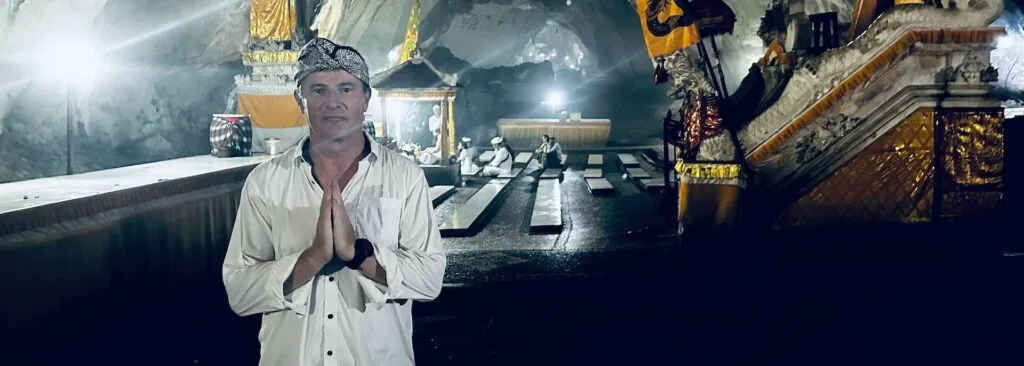
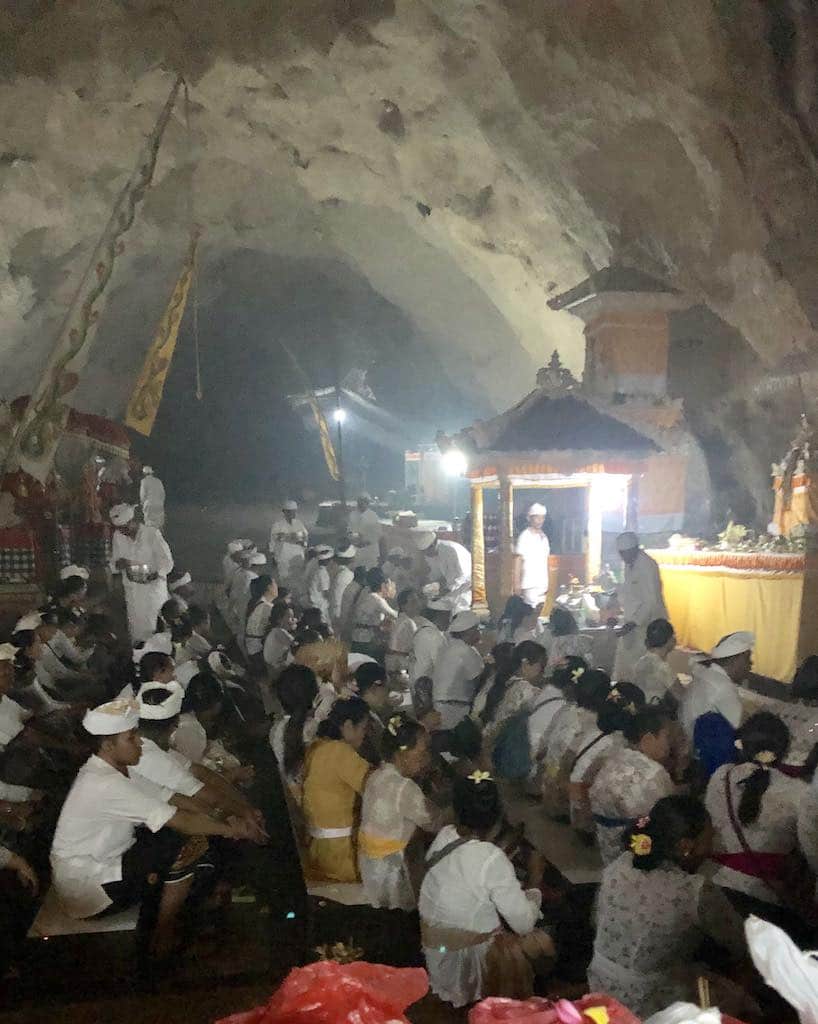
Nestled inside the largest cave on Nusa Penida, the Goa Giri Putri temple is the island’s most visited and most sacred temple. Many Balinese make a pilgrimage to this holy site, travelling from mainland Bali to follow a comprehensive purification ritual that runs through six shrines inside the cave, after an initial ceremony at the entrance. The spring water flowing through the temple is believed to have natural healing properties, which adds to its draw. Dressed in white and carrying offerings, devotees arrive on speed boats to take part in the ritual, though many head back to Bali the same day, still wary of the island’s old reputation. Pura Goa Giri Putri is a must-see among the 15 most prominent places to explore on Nusa Penida.
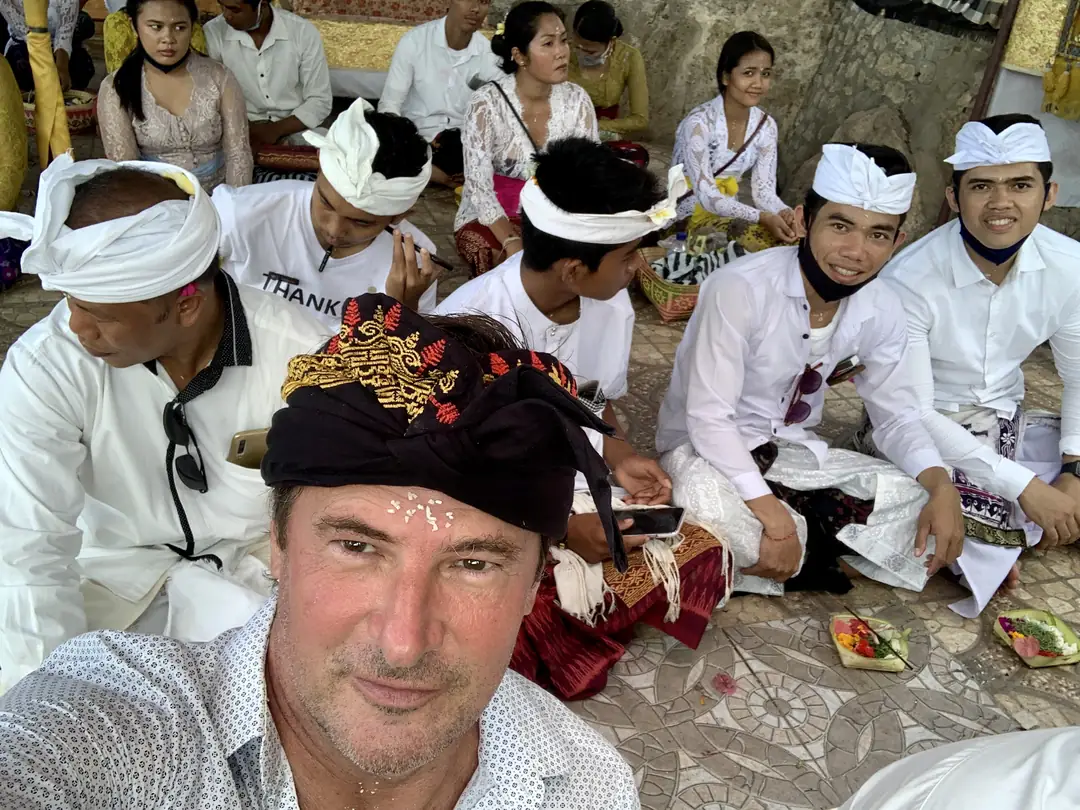
I first visited Goa Giri Putri on 5 June 2015 and have come back at least once a year ever since, often joining the ceremonies myself. This guide gathers what I have learned over those visits — what the temple means, how to get inside, what happens during the ceremonies, and the practical details (entrance fee, sarong, opening hours) that most visitors ask about.
Goa Giri Putri at a glance
- Where: north-east coast of Nusa Penida, near Suana, about 30 minutes from Toyapakeh harbour.
- Entrance fee: a fixed 50,000 IDR per person (it replaced the old free-donation system).
- Opening hours: open daily; visitors are generally welcome from around 7am to 5pm. Early morning is the quietest. The temple may close to tourists during major ceremonies.
- Dress code: a sarong is compulsory — you can rent one at the entrance if you don’t have your own.
- How long: 30 to 45 minutes for a free visit; about 2.5 hours for the full purification circuit.
Need help planning your visit? Roy can help you organise your day on the island.
What does Pura Goa Giri Putri mean?
In Balinese, “Goa” means cave, “Giri” means hill, “Putri” means princess or daughter, and “Pura” means temple. So Pura Goa Giri Putri is a very descriptive name for a temple built inside a cave in a hill, dedicated to Shiva. Shiva’s role is to destroy the universe in order to re-create it; together with Brahma and Vishnu, he forms the triumvirate in charge of the creation, preservation and destruction of the world. It is one of the most important of all the temples on Nusa Penida, which is why it draws so many Balinese pilgrims.
Entering Pura Goa Giri Putri
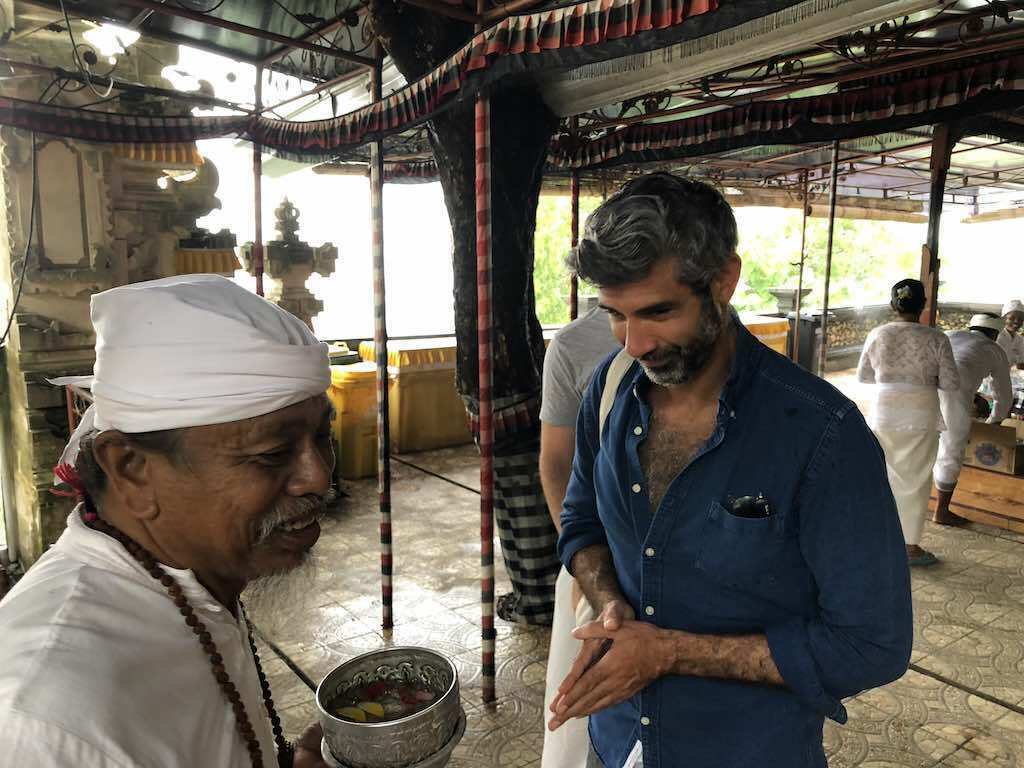
The temple is about 30 minutes from Toyapakeh, following the good coastal road along the north of Nusa Penida. You can rent a sarong at the small shop selling drinks if you don’t have one. Cross the road and climb the fifty-odd steps. After paying the entrance fee (now a fixed 50,000 IDR per person) and going through a quick purification ceremony, you are ready to enter the temple. The priest will usually show you the way in, because the entrance is not easy to find: you slip in almost crawling through a very narrow passage between the rocks.
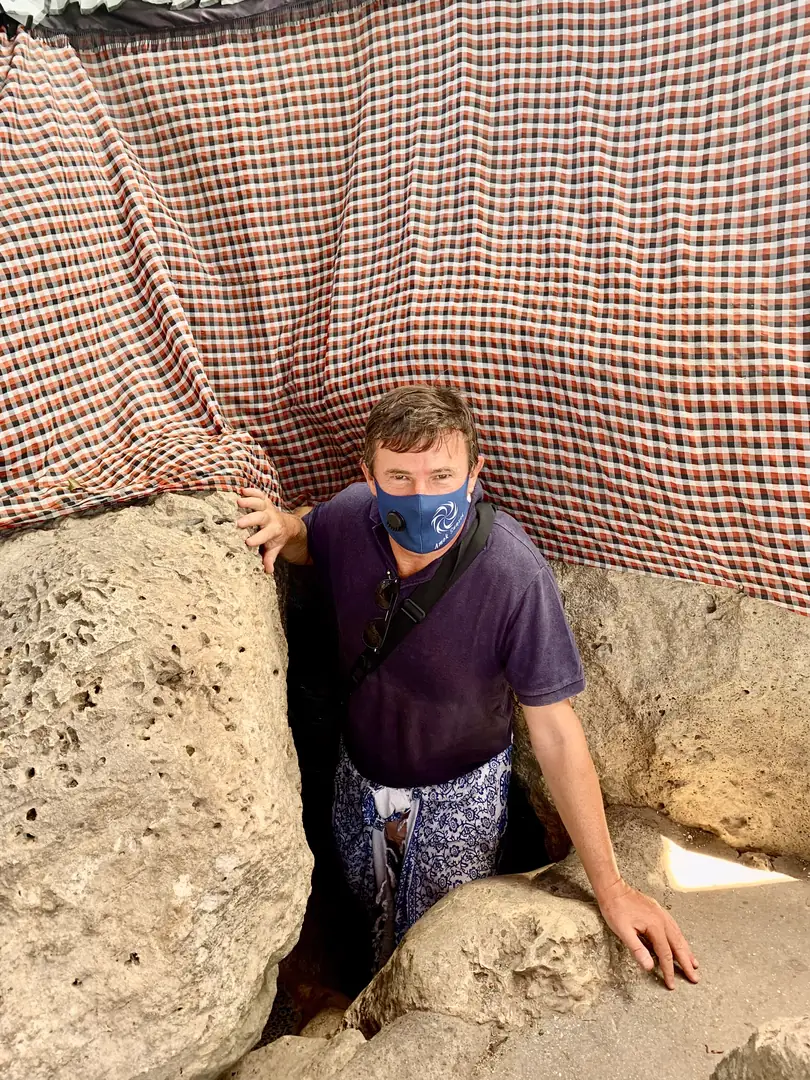
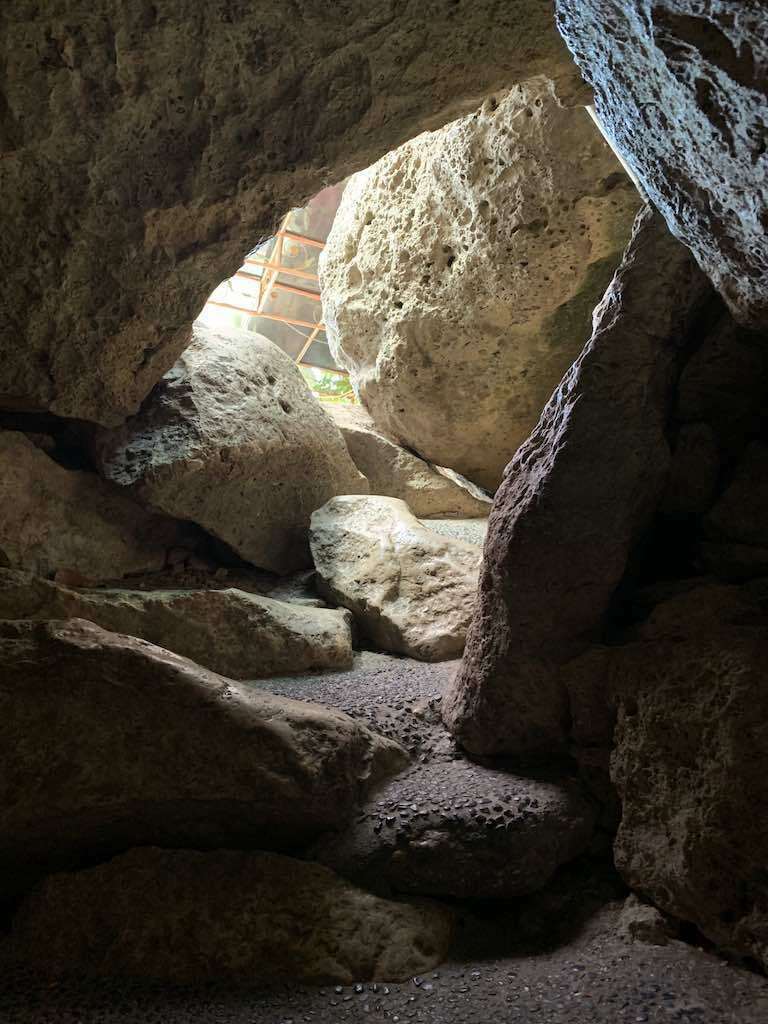
After a few meters, the passage opens into a huge cave. There is artificial light, so you won’t be left in the dark. Follow the path and walk among the different shrines. The full purification process takes place at each shrine and lasts around 2 hours and 30 minutes, but you can do it at a faster pace. Halfway along, you’ll see a small staircase leading up; depending on the priests on duty, you may or may not be allowed to climb it. If you are at all claustrophobic, it is better to skip it — the space up there is tight and a little suffocating, a kind of cave within the cave. Here too is how to get to Nusa Penida from Bali.
Inside the cave: the six stations
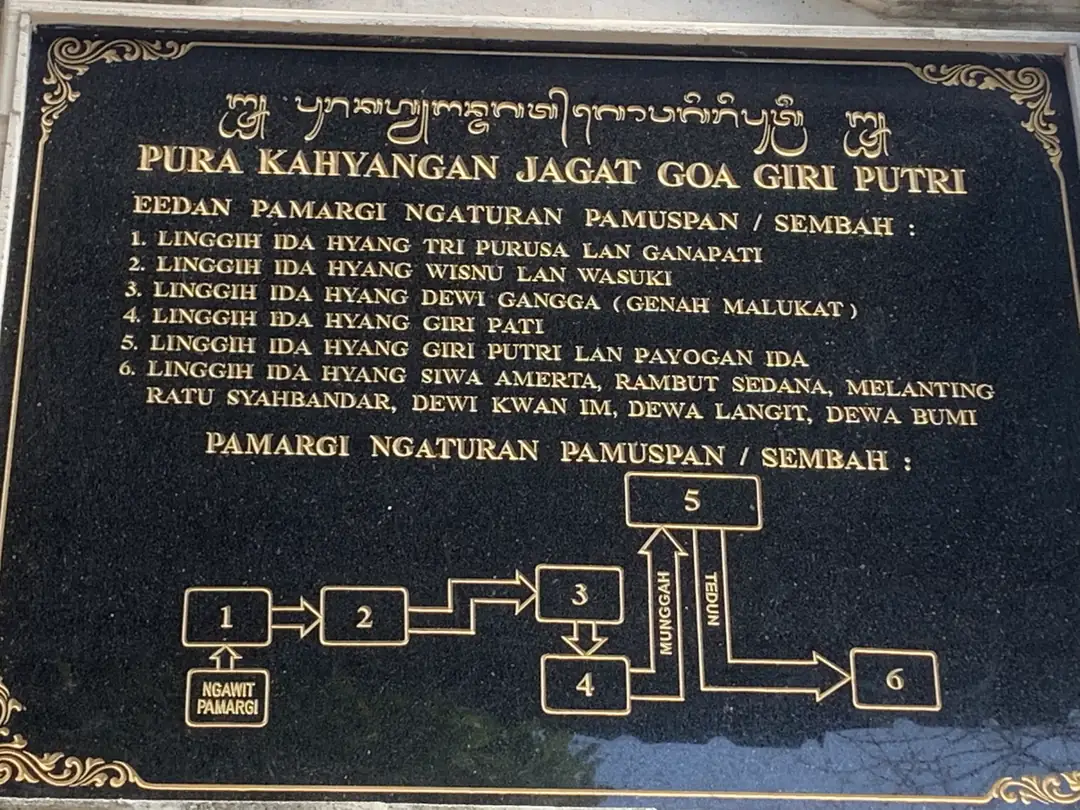
Inside, the purification circuit runs through six shrines (linggih), each dedicated to different deities, as set out on the temple’s own stone plan at the entrance. In order, you pass: (1) Tri Purusa and Ganapati; (2) Vishnu and Wasuki; (3) Dewi Gangga, the holy-water station where the cleansing (malukat) takes place; (4) Giri Pati; (5) Giri Putri, the temple’s namesake; and (6) a final shrine grouping several deities, including Siwa Amerta and Dewi Kwan Im (Guanyin), the Chinese Buddhist goddess of compassion — which is why the temple blends Hindu and Buddhist worship. You don’t have to complete every station, but doing the full circuit is the best way to understand why this cave matters so much to the Balinese.
The Trimurti bracelet and the two ceremonies
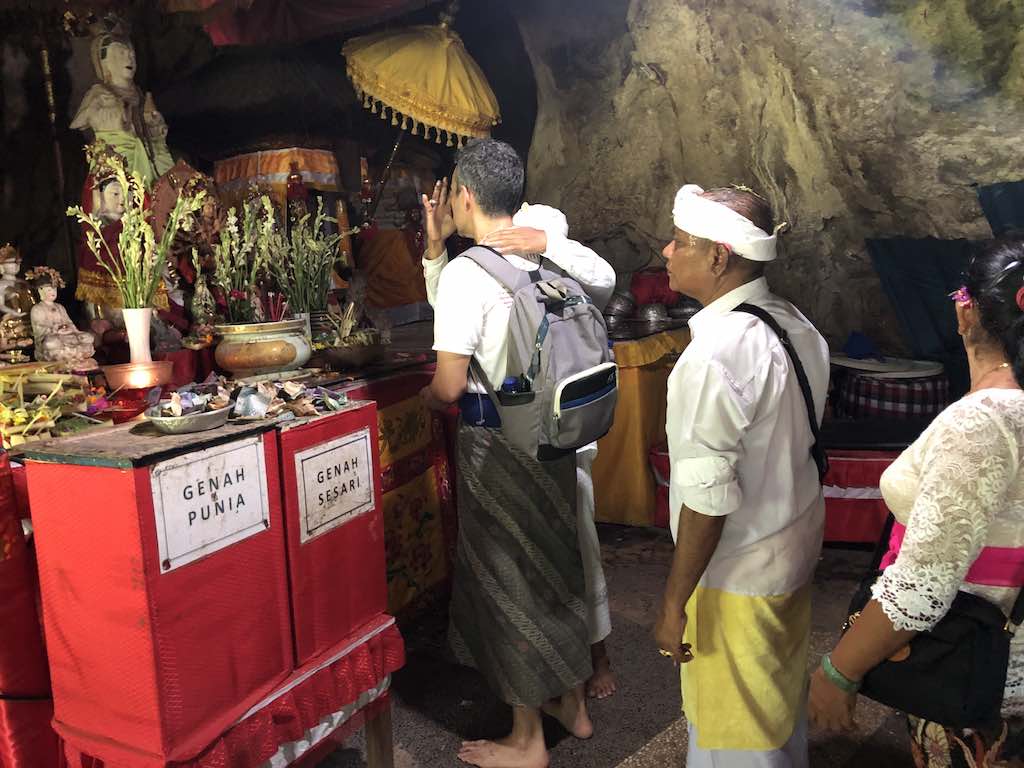
Don’t miss the final ceremony at the last shrine in the cave — it is open to tourists, but you have to ask for it. The priests sometimes doze on a bench, yet I have never seen them turn down a ceremony. There are in fact two, as the temple combines Hindu and Buddhist traditions.
At the end of the Hindu ceremony, the priest ties the famous Balinese red, white and black bracelet onto your wrist. Its three cords stand for the three gods of the Trimurti: Brahma, Vishnu and Shiva. Beforehand you drink holy water poured into your hands three times, then press a few grains of rice onto your forehead.
At the other, Buddhist ceremony — dedicated to Guanyin, the Chinese Buddhist goddess of compassion — the priest leads you through a short purification and meditation and marks your forehead with a little ash. Don’t worry, it’s very brief.
Plan a small donation after the ceremonies. You then leave Goa Giri Putri through the far end of the cave, which opens onto a lovely view over a small valley.
After Pura Goa Giri Putri
After visiting Pura Goa Giri Putri, you can easily continue your day at Atuh Beach and Diamond Beach, two of the most spectacular sites on Nusa Penida’s east coast. For inspiration and logistics, see our guide to tours in Nusa Penida. To understand the spiritual background of the places you’re visiting, explore our page on the culture and history of Nusa Penida. And for a complete overview to plan the rest of your stay, find everything you need in our Nusa Penida travel guide.
Visiting Goa Giri Putri on a tour
Goa Giri Putri is one of the highlights of East Nusa Penida, and it pairs naturally with Diamond Beach, Atuh Beach and Peguyangan waterfall on the same day. If you’d rather not ride a scooter and find the cave yourself, my trusted driver Roy can organise a private day tour that includes Goa Giri Putri, with optional stops along the way; he can also arrange your fast boat tickets and hotel pickup if you’re coming from Bali for the day. The temple also features on several of our guided Nusa Penida tours and itineraries, which give you time to see both the temple and the island’s main viewpoints without rushing.
Message Roy on WhatsApp to check availability, prices and the best itinerary for your date.
Nusa Penida Travel Guide
Plan your trip to Nusa Penida with our local expert guide: beaches, diving sites, hotels, transport tips, itineraries and seasonal advice.

Where to stay in Nusa Penida
How to choose where to stay in Nusa Penida among the 500 listed hotels. 5 stars, boutique hotel, glamping or charming bungalows?
Top 15 to see in Nusa Penida
After more than 10 years exploring Nusa Penida, I’ve updated my list of the 15 most incredible places to see on the island — from stunning beaches to dramatic cliffs.
Goa Giri Putri FAQ
Where is Goa Giri Putri located?
Goa Giri Putri is on the north-east coast of Nusa Penida, near the village of Suana, about 30 minutes by scooter from Toyapakeh harbour along a good coastal road. The temple is set on a hillside, reached by about fifty Balinese steps. Parking and sarong rental are available at the foot of the stairs.
How much is the entrance fee to Goa Giri Putri?
Entry is a fixed fee of 50,000 IDR per person, which replaced the old voluntary donation. Renting a sarong, if you need one, costs a few thousand rupiah extra. A small donation after the ceremonies inside the cave is also customary.
What are the opening hours of Goa Giri Putri?
As an active temple it is open daily, and visitors are generally welcome from around 7am to 5pm. Early morning is the calmest and coolest time, before the day tours arrive. The temple can close to tourists during major Hindu ceremonies, so it’s worth checking locally if your trip falls on a festival day.
Do I need a sarong to visit Goa Giri Putri?
Yes. A sarong is compulsory to enter, as in every Balinese Hindu temple. If you don’t have one, you can rent a sarong at the entrance for a few thousand rupiah. Covering your shoulders is also appreciated out of respect for the site.
How long does it take to visit Goa Giri Putri?
A free visit through the cave takes about 30 to 45 minutes. If you follow the complete purification circuit through all six stations with the priests, allow around 2 hours and 30 minutes.
What is the Trimurti bracelet?
At the end of the Hindu ceremony inside the cave, the priest ties a bracelet of three cords — red, white and black — onto your wrist. The three colours represent the gods of the Trimurti: Brahma (creation), Vishnu (preservation) and Shiva (destruction and recreation). It is traditionally worn until it falls off naturally.
Is Goa Giri Putri suitable if you’re claustrophobic?
The main entrance is a narrow passage of a few metres, but it is short and manageable, and the cave opens into a huge, airy chamber straight after. The one part to avoid if you’re claustrophobic or prone to vertigo is the small inner staircase leading to a tight “cave within the cave” — it is optional, so you can simply skip it.
Can you take photos inside Goa Giri Putri?
Yes, photography is generally allowed inside the cave, and the shafts of light breaking through the rock make it very photogenic. Be discreet and respectful during ceremonies, avoid using flash on people who are praying, and always ask before photographing a priest or a worshipper up close.
About the author
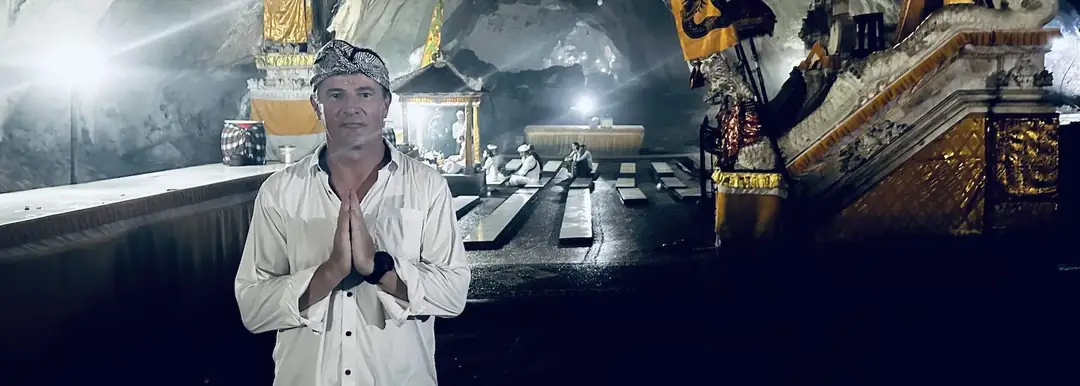
This guide was written by Blaise Jaeger, who has lived and worked on Nusa Penida since 2017 and opened the island’s first PADI dive centre. He first visited Goa Giri Putri in 2015 and has returned to its ceremonies at least once a year ever since.
Pingback: Nusa Penida: Paradise for Adventure Seekers - Beautiful Planet 4K