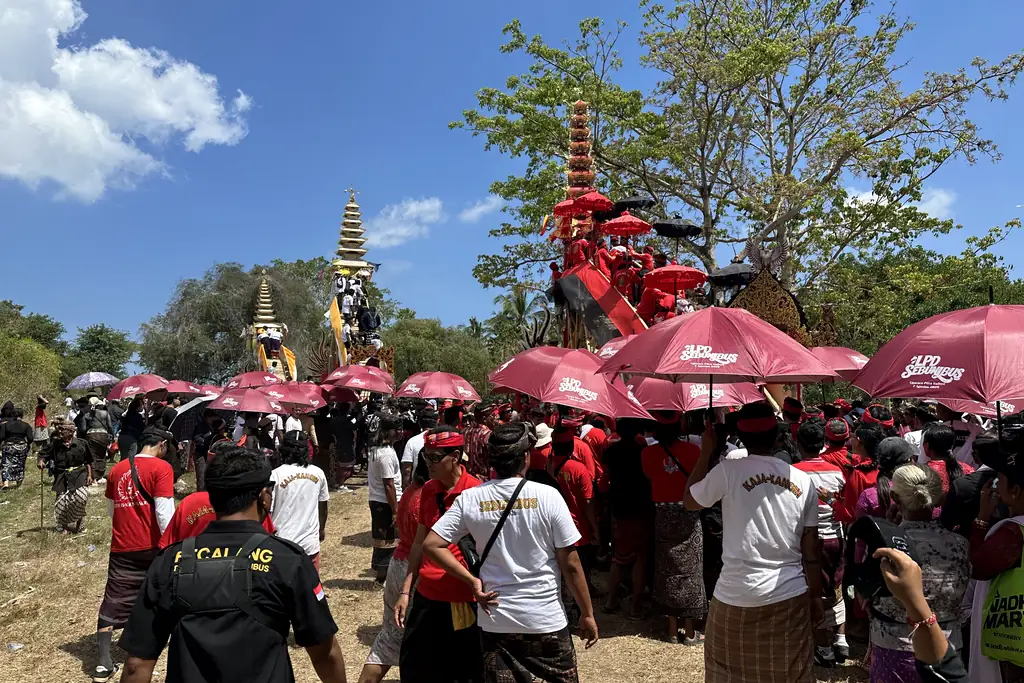
Ngaben is often described simply as the Balinese cremation ceremony. What I witnessed in Sebunibus, Nusa Penida, in August 2026 was much more than a cremation. Over two days, I followed a collective ceremony involving 83 deceased villagers: graves were opened, bones were recovered and washed by the families, the remains were carefully identified and carried in procession, then three days later placed inside elaborate animal-shaped petulangan before the final cremation.
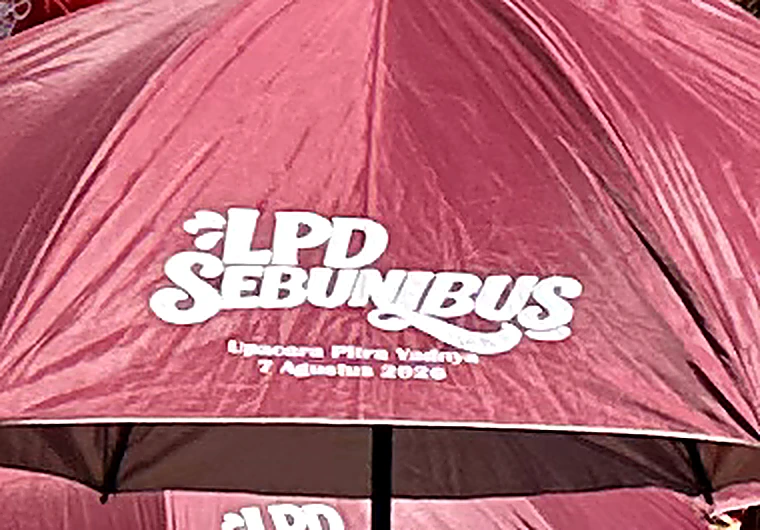
The village itself used a broader term for the event. On the ceremonial umbrellas I photographed on 7 August, the inscription reads “LPD Sebunibus — Upacara Pitra Yadnya — 7 Agustus 2026.” That distinction matters. Ngaben is the cremation phase within the wider Pitra Yadnya rites devoted to the deceased and ancestors.
This article is therefore both a guide to Ngaben and a first-hand record of one specific collective Pitra Yadnya in Sebunibus. That qualification is important: Balinese ritual practice varies between villages, families and regions. I was also told that this stage can be very different elsewhere in Bali. In another Balinese village, for example, the exhumation is symbolic and the bones themselves are not dug up. In Sebunibus, by contrast, the physical recovery and cleaning of the bones was one of the central acts I witnessed.
What is Ngaben in Bali?
Ngaben is the best-known name for the Balinese Hindu cremation rite. Its purpose is not simply to dispose of a body. In Balinese Hindu belief, cremation helps release the atma, or soul, from its material ties and allows the ritual journey of the deceased to continue.
The Bali Provincial Government’s cultural heritage portal explicitly classifies Ngaben within Pitra Yadnya, the rites associated with the deceased and ancestors. An explanation published by the Hindu Affairs office of Indonesia’s Ministry of Religious Affairs likewise presents Pitra Yadnya as a broader sequence in which Ngaben is followed by further rites of purification and ancestral transition. You can read these official Indonesian references on the Bali cultural heritage portal and the Ministry of Religious Affairs website.
Ngaben or Pitra Yadnya?
For visitors, “Ngaben” is the useful search term because it is the word most commonly associated with Balinese cremation. But describing the entire Sebunibus event as nothing more than a cremation would be incomplete. The villagers explicitly called it an Upacara Pitra Yadnya, and the ritual process continued after the fire, through the sea, Pura Dalem Puri, Pura Besakih, Pura Goa Lawah and eventually the family temple.
Ngaben rituals are not the same everywhere in Bali
This is probably the most important warning to keep in mind while reading this guide. There is no single photographic sequence that can be presented as the universal way a Ngaben unfolds across Bali.
I was also told that the ceremony can be significantly different elsewhere in Bali. The most striking difference concerns the grave: in Sebunibus, families physically exhumed the remains and cleaned the bones. In another Balinese village, for example, the same stage is carried out symbolically, without digging up the bones themselves.
That is why, throughout this article, I use phrases such as “in Sebunibus” whenever I describe a local practice: cleaning with alang-alang grass, the handling of the empty grave, the numbered bags, the procession to the petak, or the way the remains were transferred to the petulangan. These details are first-hand observations of this particular Nusa Penida ceremony, not rules for every Ngaben in Bali.
Ngaben and the Balinese cycle of life
To understand why Ngaben matters so deeply, it helps to see it in the wider Balinese Hindu ritual system. The five broad categories of yadnya are commonly known as Panca Yadnya: Dewa Yadnya, Rsi Yadnya, Manusa Yadnya, Pitra Yadnya and Bhuta Yadnya.
Manusa Yadnya accompanies the stages of human life, from pregnancy and birth through childhood, coming of age, tooth filing and marriage. Academic literature on Balinese ritual describes 13 Manusa Yadnya ceremonies marking stages of human life, although names, grouping and practice can vary. A peer-reviewed ethnobotanical study of Balinese religious offerings also identifies 13 ceremonies within Manusa Yadnya. Pitra Yadnya then concerns the obligations to the deceased and ancestors. In that sense, Ngaben is not an isolated spectacle: it belongs to a much longer ritual understanding of life, death, purification and ancestry.
This was one of the most useful things I had previously seen explained visually at the Samsara Living Museum in Bali: a Balinese life is accompanied by ceremonies from before birth until after death. Ngaben only makes full sense when viewed within that continuum. For a scholarly overview of the five Yadnya categories and the 13 Manusa Yadnya ceremonies, see this peer-reviewed study of ritual offerings in Bali.
Why I attended the Sebunibus Pitra Yadnya
I did not go to Sebunibus simply because I had heard that a spectacular cremation was taking place. The ceremony concerned people I work with on Nusa Penida: six members of the Adiwana Warnakali team and one member of the Dune Penida team had deceased relatives included among the 83 sawa.
I attended primarily as a mark of respect for them and their families. Pak Alit, the Balinese manager of Adiwana Warnakali, accompanied me and helped me understand what was happening. We met at 6:00 am on 4 August so he could help me dress appropriately in Balinese ceremonial clothing, including a kamen, before we went to the cemetery. Unless otherwise stated, the local explanations of the Sebunibus ritual in this article come from the detailed debrief we had after the ceremony, while descriptions of what happened and the timings come from what I personally witnessed and recorded.
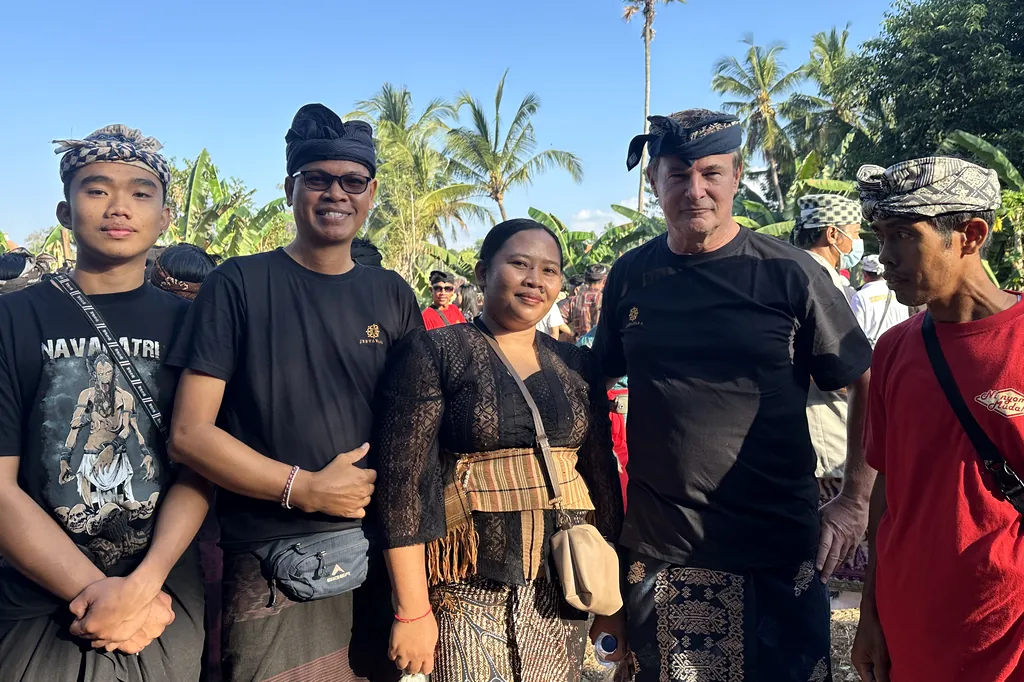
After the ceremony I spent about two hours going back through my notes and questions with him. The detailed chronology below combines what I personally saw with those local explanations. Where I describe my own impressions, I say so, and I avoid presenting Sebunibus practices as universal Balinese rules.
How a collective Ngaben is organised in Sebunibus
The Sebunibus ceremony involved 83 sawa, according to the count given to me locally. I use sawa here for the deceased/remains participating in the ritual process rather than forcing a single English equivalent onto every stage. The Klungkung Regency notice independently confirms Sebunibus’s collective Pitra Yadnya and its 7 August peak date, but it does not publish the village’s total number of sawa.
Collective Ngaben ceremonies are clearly established on Nusa Penida and elsewhere in Bali, while other families and communities may organise cremation differently, including individual ceremonies. Holding the ritual collectively allows families to share major costs and community resources. The interval is not fixed: in Sebunibus it depends on a decision by the customary village community rather than an automatic five-year rule.
The date is decided well in advance. In Sebunibus, the customary village committee — the Pengurus Desa Adat Sebunibus — works with the priest, or Ratu Pedanda, and uses combinations within the Balinese calendar, including Sapta Wara, Panca Wara, Wuku and Tri Wara, to determine the appropriate date.
There is also unusually precise official documentation for this particular ceremony. On 4 August 2026, the Klungkung Regency government published a notice naming Desa Adat Sebunibus among the Nusa Penida communities receiving support for “Pitra Yadnya (Ngaben Massal)”. It records Rp150 million in assistance for Sebunibus and states that the peak of the ceremony was scheduled for 7 August 2026 — independently confirming both the village and the date visible on my photographs. The same notice explains that the regency’s support scheme is calculated at Rp5 million per sawa, subject to a maximum of Rp150 million per customary village or group. See the official Klungkung Regency announcement.
Why are some deceased buried before Ngaben?
One of the biggest misconceptions is that every Balinese person is cremated immediately after death. In Sebunibus, many deceased are buried first and may remain in the cemetery until a collective ceremony is organised. Cost is part of the explanation, because families need time to prepare for a major communal rite, but the waiting period was also explained to me in spiritual terms as part of the atma’s progression and purification.
As part of a collective Ngaben in Sebunibus, every grave in the cemetery is opened and emptied. The cemetery has to be cleared. This means that when the ceremony takes place, participation is not optional for a deceased person who is still buried there — and it is why the date matters to every family in the village at once, not only to those who have recently lost someone.
This creates a practical issue when someone dies during the twelve months before the scheduled Ngaben: the body may not have enough time to decompose fully. In that case, the body is cremated soon after death and the ashes are scattered at sea, with a simpler ceremony — or in a river, where a community is far from the coast. Such a person is not left out of the collective rite: they rejoin it at the Ngulapin ceremony described below.
4 August 2026: exhuming and preparing the remains
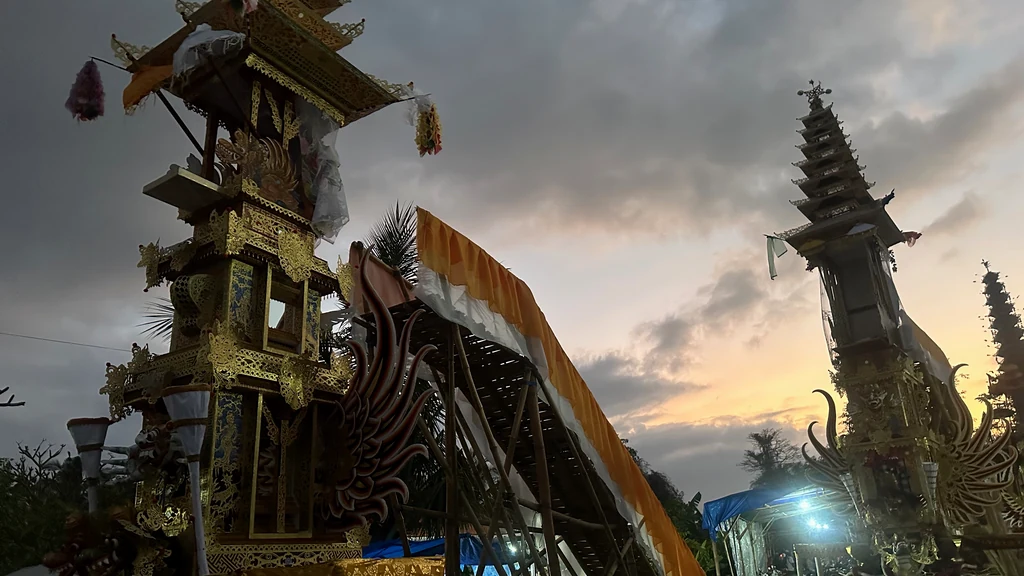
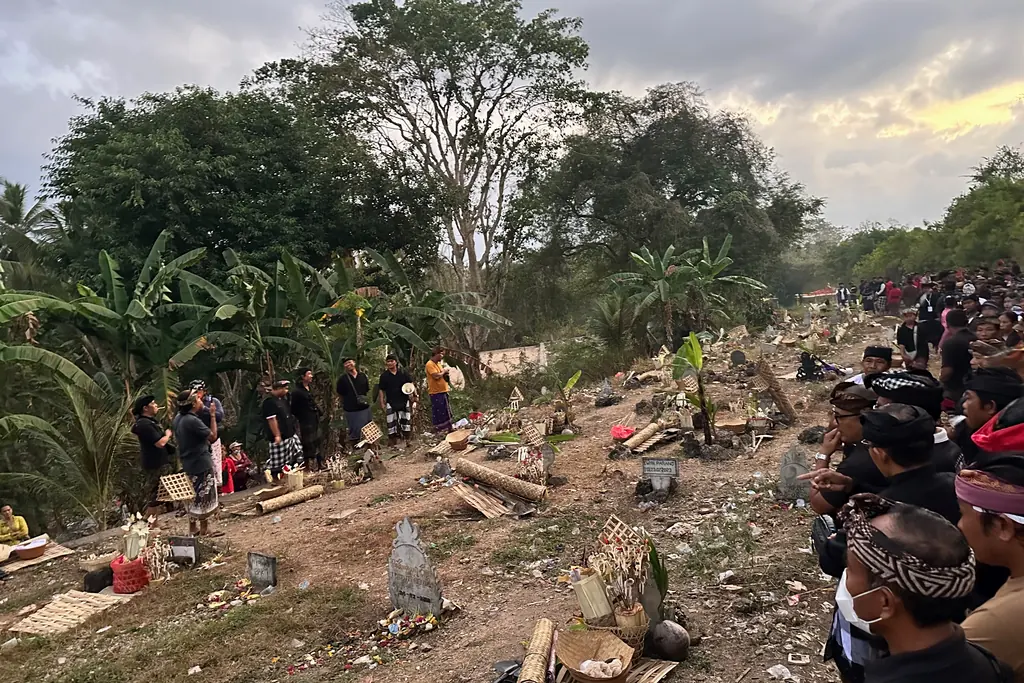
When we arrived shortly after 6:00 am, the village was already busy. Before reaching the cemetery, we passed the large ceremonial towers that would be used later in the ritual.
Behind the cemetery, members of the Pengurus Desa Adat Sebunibus and pecalang, the traditional community security personnel, supervised the proceedings. Instructions were given progressively over a microphone. The graves were blessed, and groups moved around the cemetery making music and striking or tapping the ground. This was explained to me as a way of announcing to the sawa that the moment had come and that they would soon be brought out of the graves.
Around 7:00 am: the graves are opened
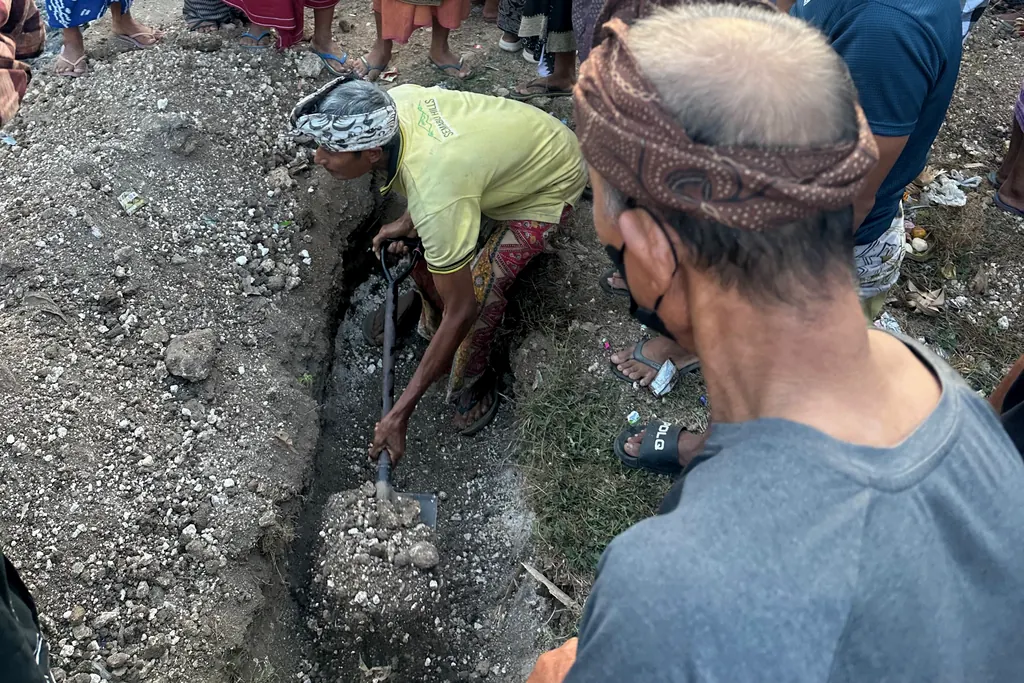
At around 7:00 am, the signal was given and families moved to their own graves. In the families I observed, the digging was mainly done by men. They worked down through the earth until they could isolate the burial shroud.
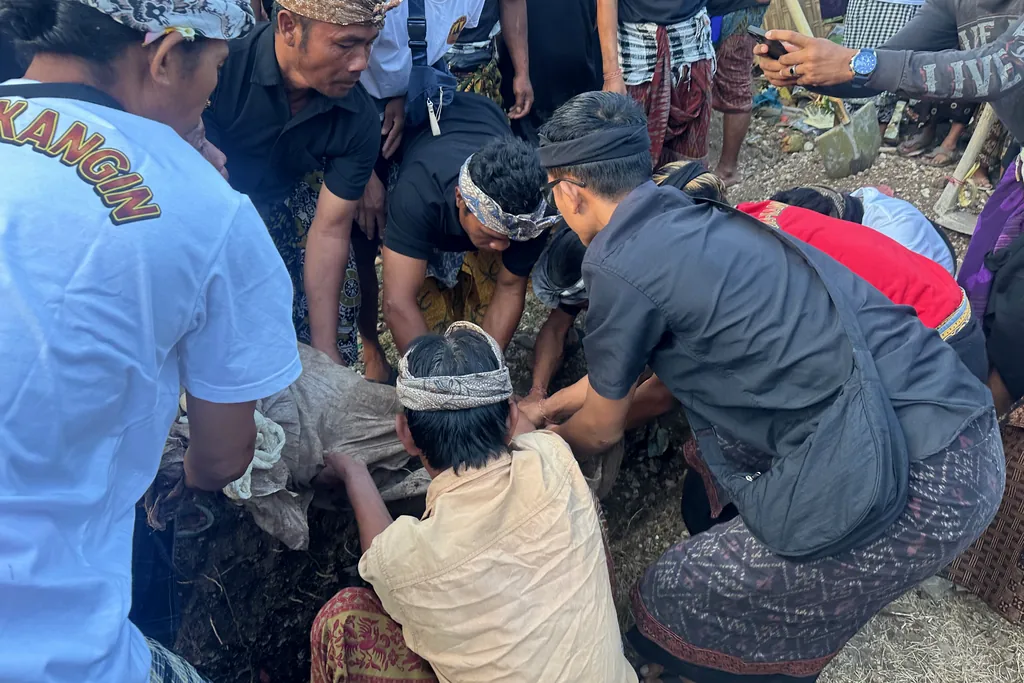
The shrouded remains were then carefully lifted out by the family. This was not a detached operation performed by cemetery workers. The family itself was physically involved.
What happens to the empty grave?
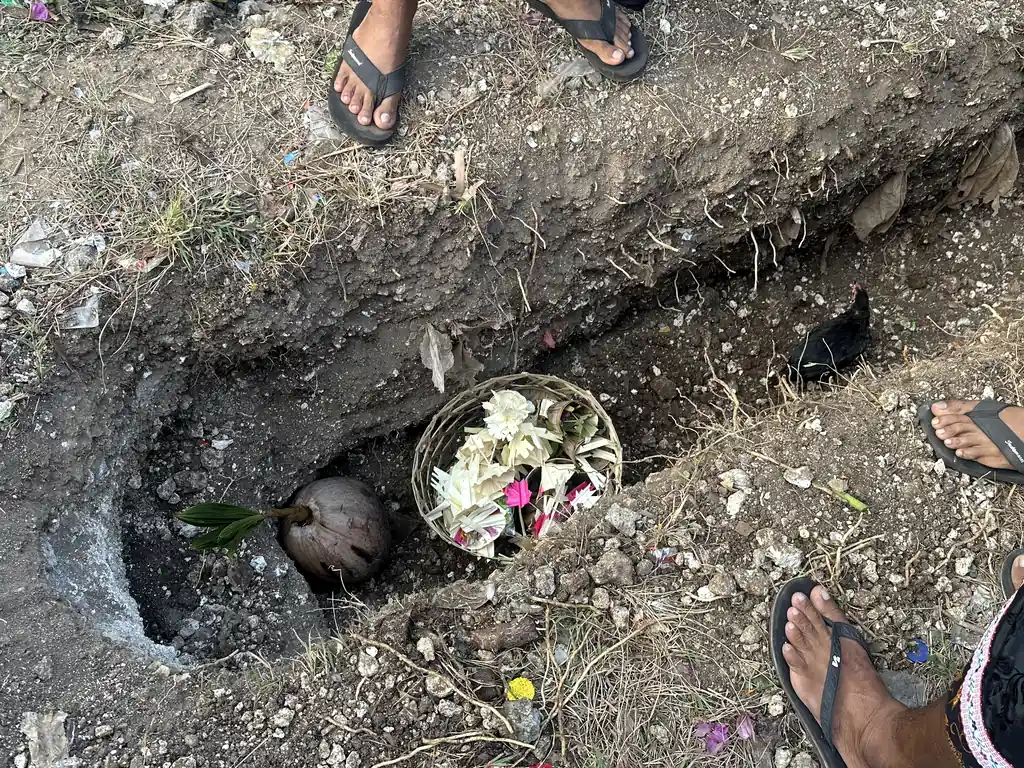
After the remains had been removed, I saw a coconut, offerings and a live chicken placed in the grave. Pak Alit later explained that the chicken, like the banana material also used at this stage, stands as a symbolic replacement for the body that has just been taken out. I saw some chickens come out of the grave on their own, while in other cases family members tossed the chicken into the air so that it could fly out.
Cleaning the bones: a family act of care
This was the part of the ceremony that affected me most, partly because it is so rarely described in detail. Once the remains were recovered, relatives gathered around them and began cleaning the bones.
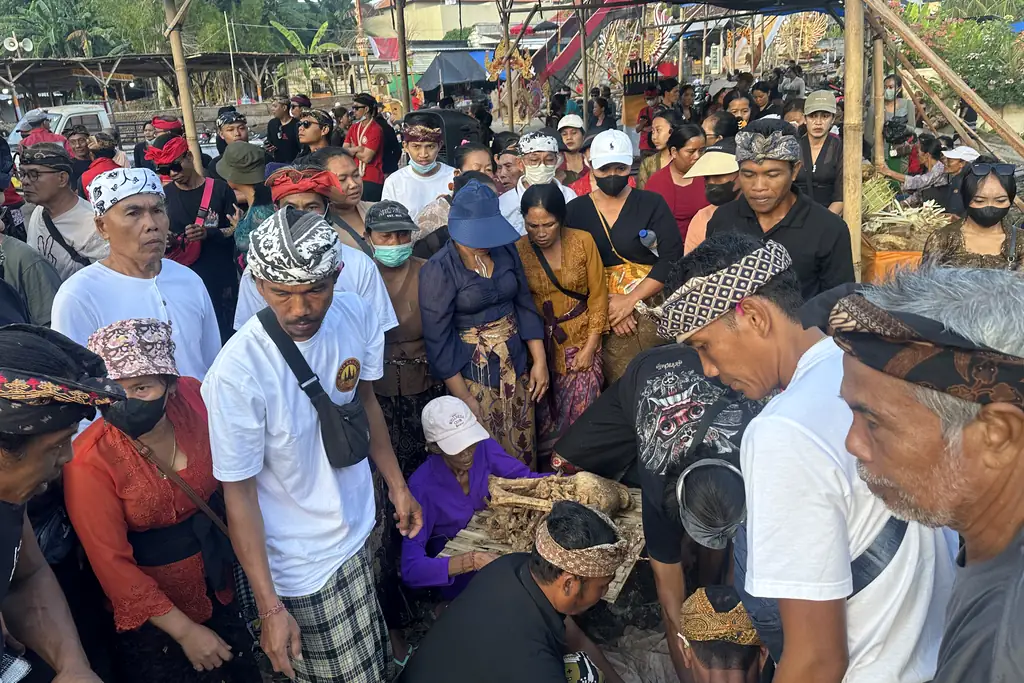
Men and women participated. I was told that everyone in the family should take part as a mark of respect.
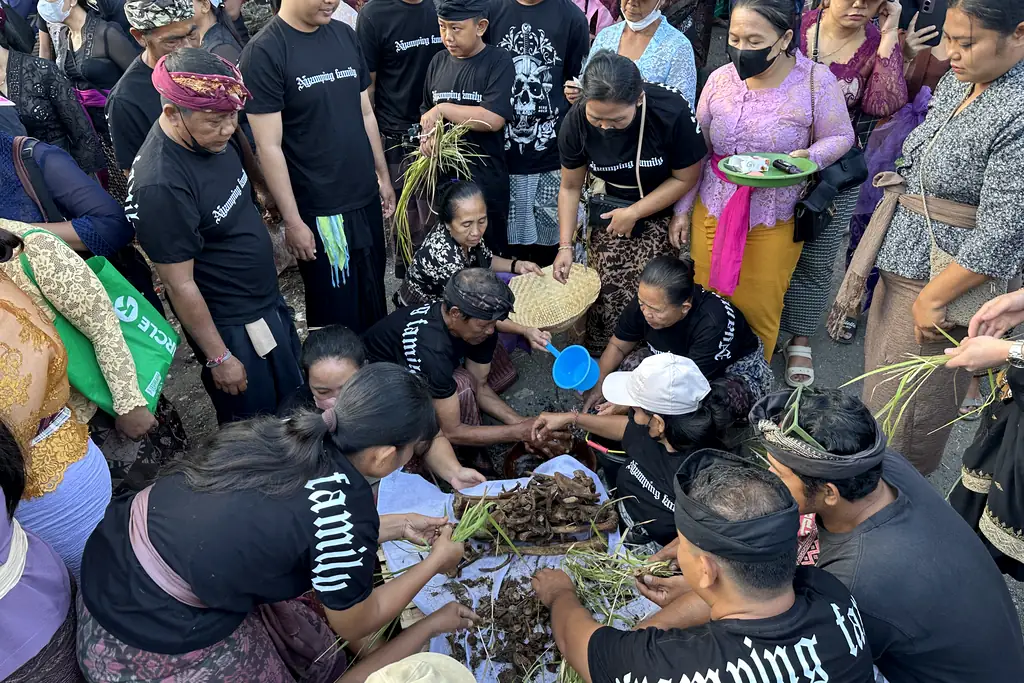
Why alang-alang grass, water and soap?
I had initially wondered whether the grass itself had a sacred meaning. I was told that, in this context in Sebunibus, it did not. The alang-alang was used practically to remove earth and dust. Together with water and soap, the process was described to me almost like washing the body itself.
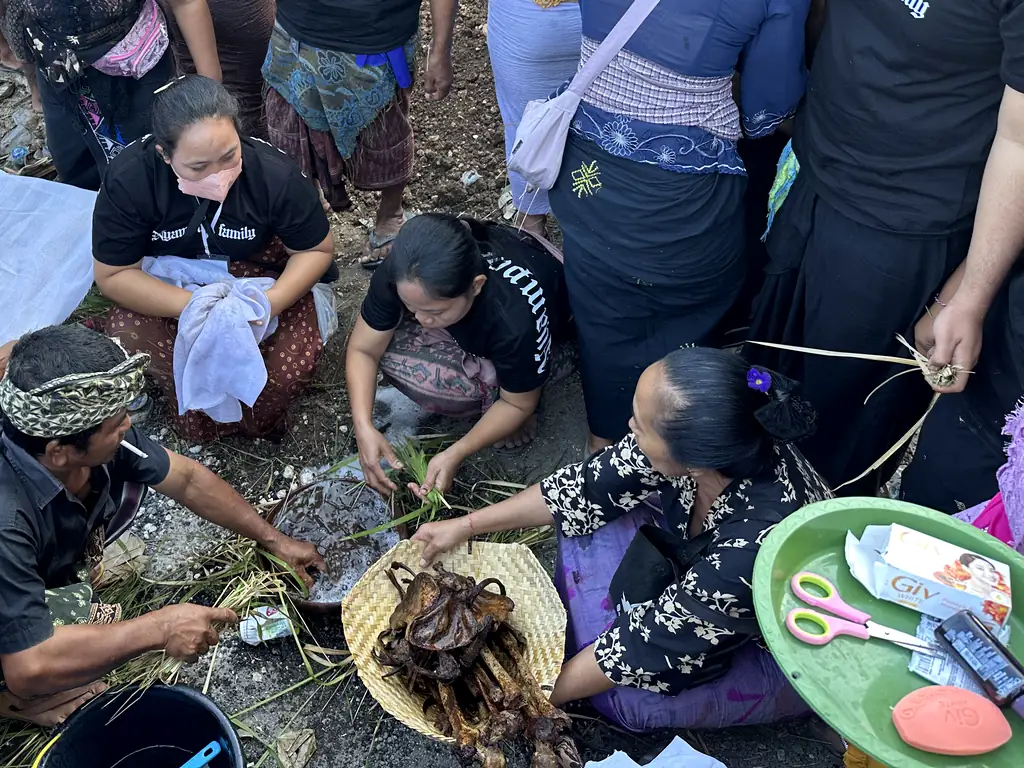
There was no special order in which the bones had to be recovered, according to the local explanation I received. What mattered was that the remains of each deceased person stayed identified. Once cleaning was complete, they were gathered and prepared for the next stage.
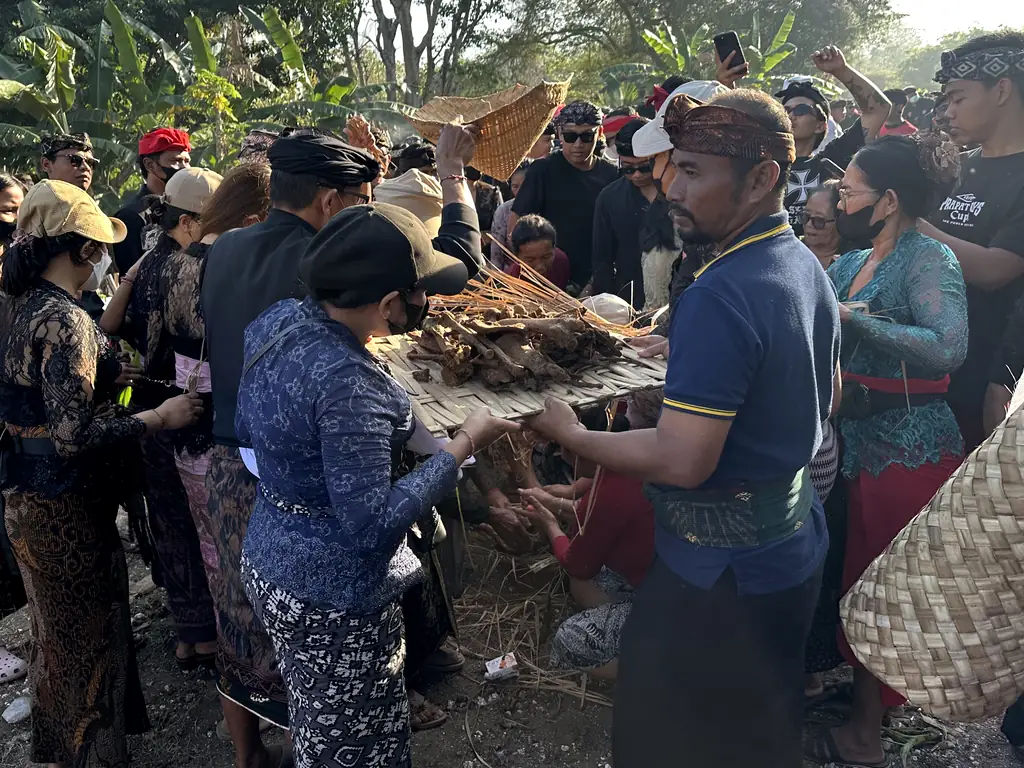
What if the body has not fully decomposed?
I was told that the remains are considered sufficiently decomposed when only bones remain. If tissue is still present, the remains are burned separately before the collective ritual continues.
Among the 83 sawa in Sebunibus, I saw only one case in which decomposition was not complete, despite the deceased having been buried for more than a year. The shrouded remains were moved to the edge of the cemetery and cremated separately before the collective ritual continued.
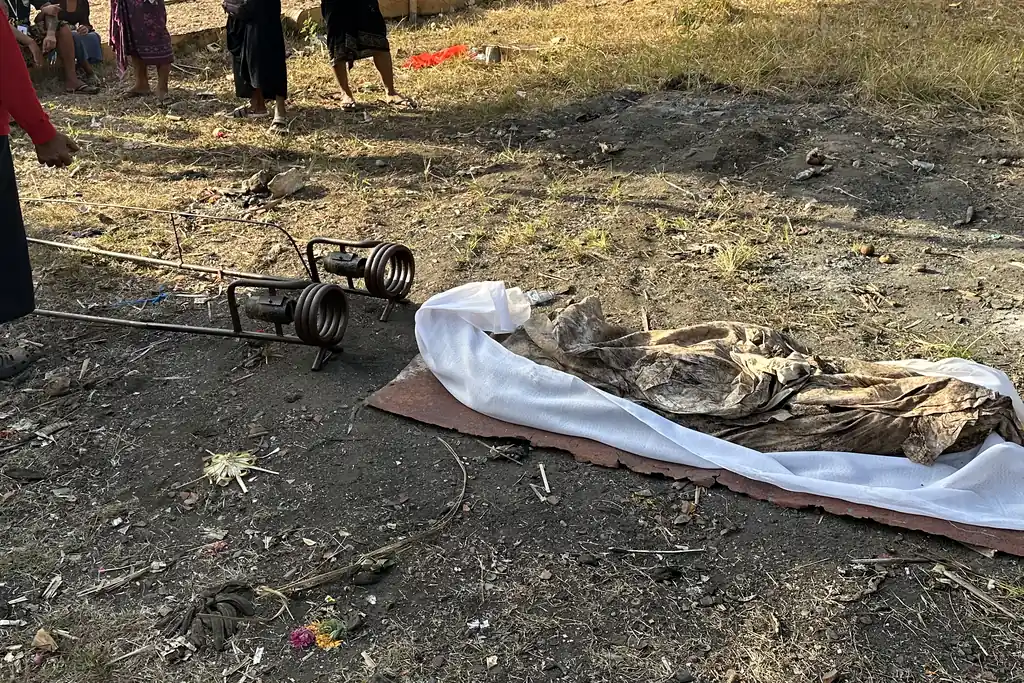
Numbered bags, parasols and the procession to the petak
Once cleaned, the bones were placed in numbered bags. The reason was practical and essential: with 83 deceased participating, each set of remains had to stay correctly identified.
Families then waited together in the shade until everyone was ready. Watching them, I was struck by how different the atmosphere was from the Western funeral mood I might instinctively have expected. There were serious and emotional moments, but also conversation, waiting, family interaction and occasional smiles. My impression was that some relatives could feel both sadness as memories returned and satisfaction that the deceased could now progress toward the next ritual stages. That is my observation of this morning in Sebunibus, not a claim about how every Balinese family experiences death.
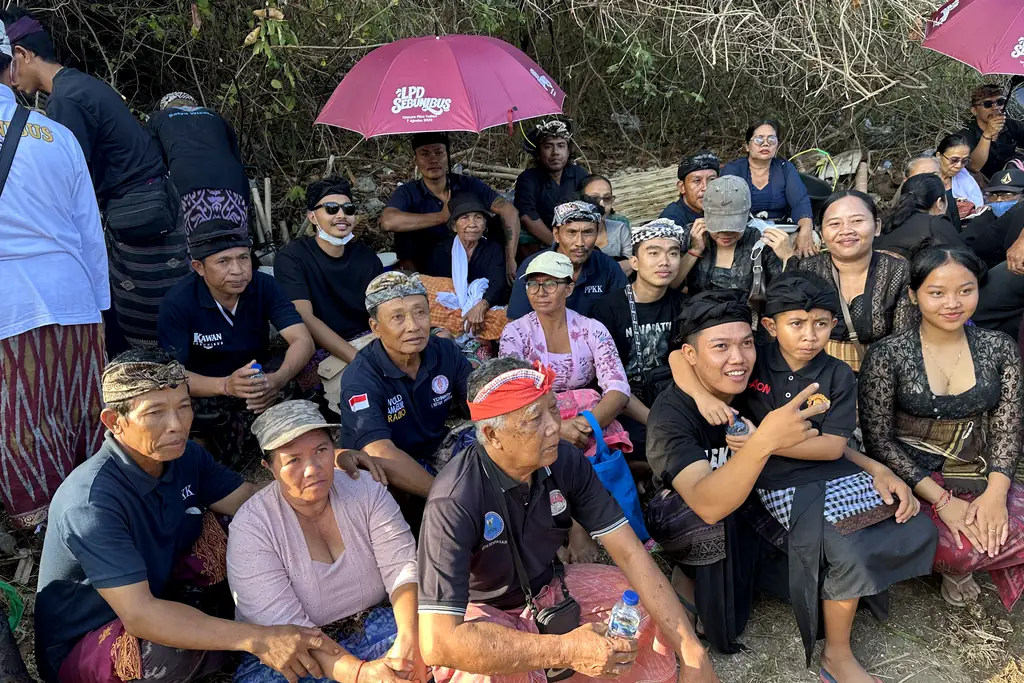
When the procession began, a family member carried the remains while another held a parasol above them. The parasol was explained to me as protecting the atma from the sun. The responsibility remained with the family.
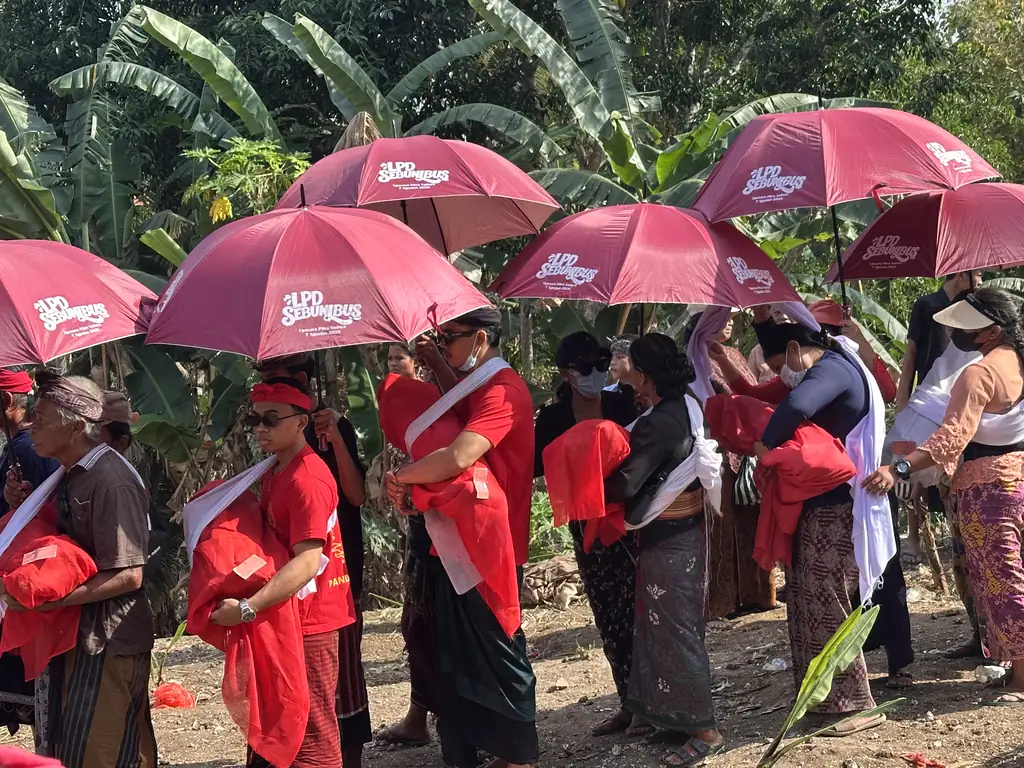
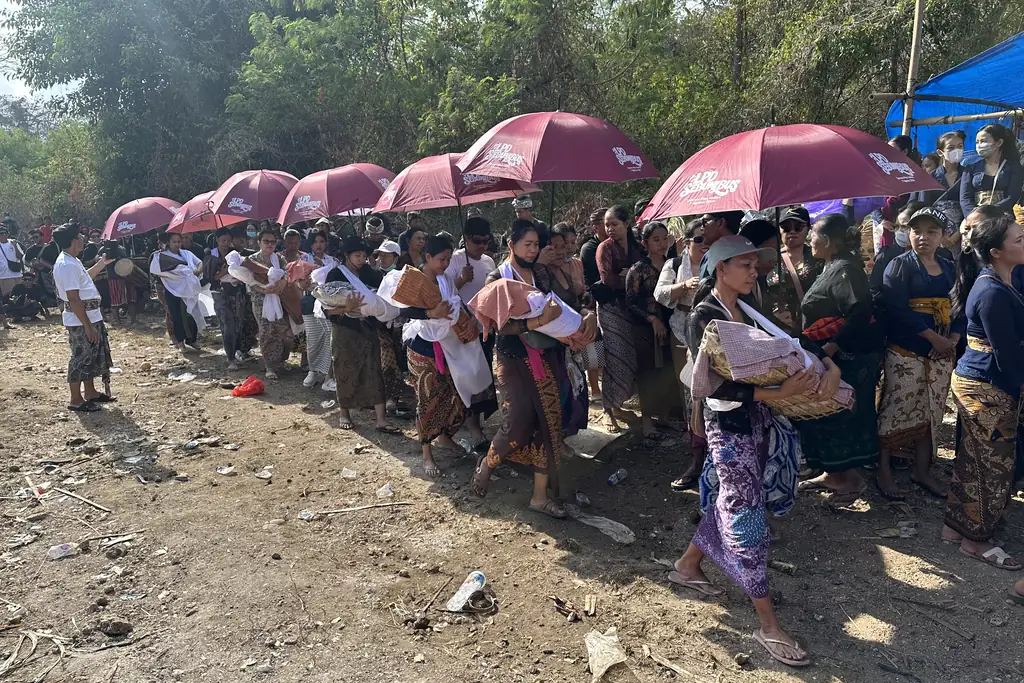
The bags were taken to the petak, a temporary ritual structure that was described to me as somewhat tent-like. It is not a permanent building: it is later dismantled, with its own purification ritual.
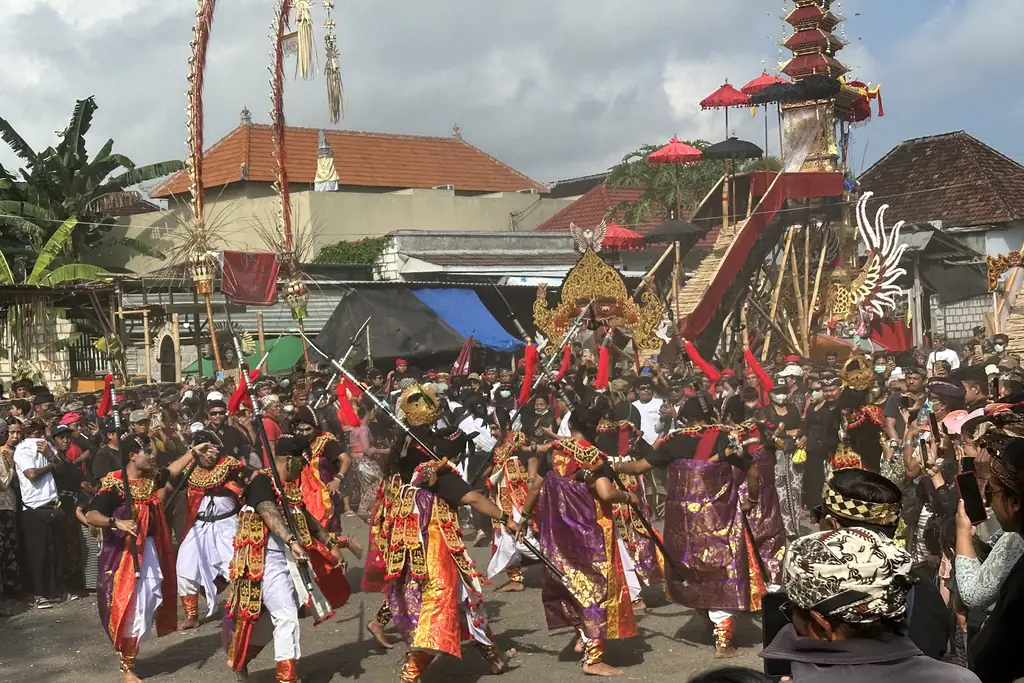
Before the morning ended, dancers performed in front of the assembled community. By around 9:30 am, the main sequence I had followed that morning was over and people began to leave.
7 August 2026: the collective cremation
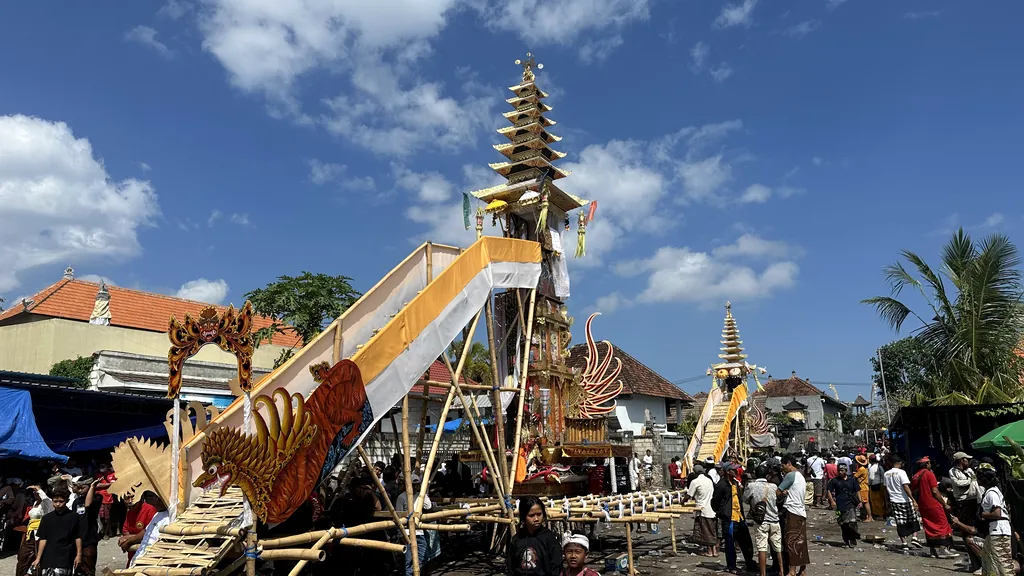
Three days later, I returned to Sebunibus. The visual atmosphere had completely changed. The first morning had been dominated by earth, graves, bones and close family gestures. On 7 August, the setting was filled with towering ceremonial structures, vivid red parasols, decorated animals and a much larger sense of public spectacle.
At around 10:30 am, the towers were in place and the numbered bags were inside. I heard these local towers referred to as Bale Page, with several tumpang, or levels. I keep the term as it was given to me in Sebunibus rather than presenting it as standard terminology throughout Bali.
Petulangan: the animal-shaped cremation structures
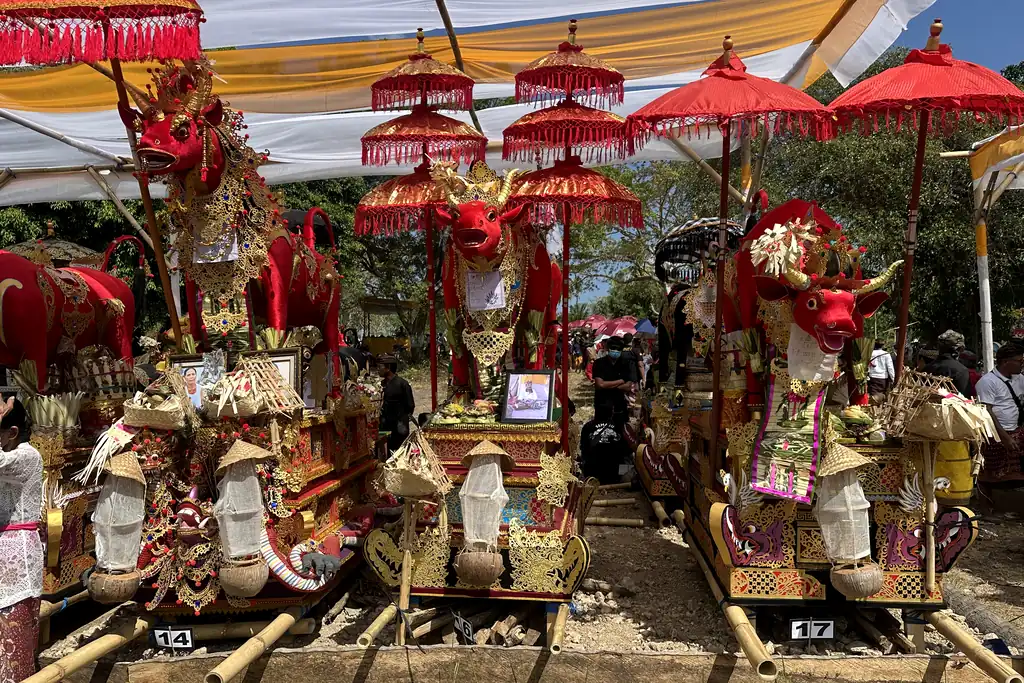
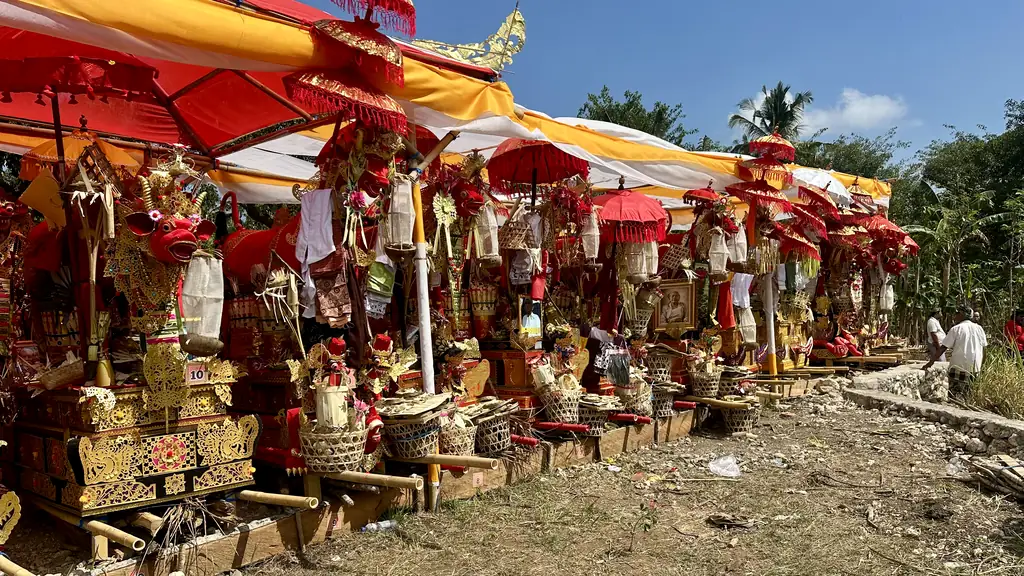
Nearby stood the structures that would actually burn: the petulangan. These are elaborate animal-shaped cremation structures, built from lightweight combustible materials including wood and paper-based decorative elements.
Lembu, Singa and Macan
Several forms were identified for me in the local ritual vocabulary: Lembu for the bovine form, Singa for lion and Macan for tiger. The choice of animal was linked to the family’s soroh, or descent group, although practices are not identical everywhere.
Several families could share one petulangan, helping divide the cost of the ceremony. I also noticed that two of the animals faced the opposite direction from the others. I asked about it because it looked deliberate, but nobody I spoke with could give me a ritual explanation. Rather than invent symbolism where none was confirmed, I simply record it as something I observed.
The Pande and the red clothing
Red was one of the dominant colours around part of the ceremony. I was told that many of the people dressed in red belonged to the Pande group, traditionally associated with metalworking, and that the colour red was connected here with Brahma. I would not turn that local explanation into a rule that “Pande wear red at Ngaben”: what I can document is what I saw in Sebunibus and how it was explained to me there.
Lowering the sawa and returning the remains to each family
At around 11:45 am, the towers became the centre of activity. Designated men climbed them and began lowering the numbered remains. On one tower I heard the deceased called by name; on two others, numbers were announced so that families could identify and retrieve the correct bundle.
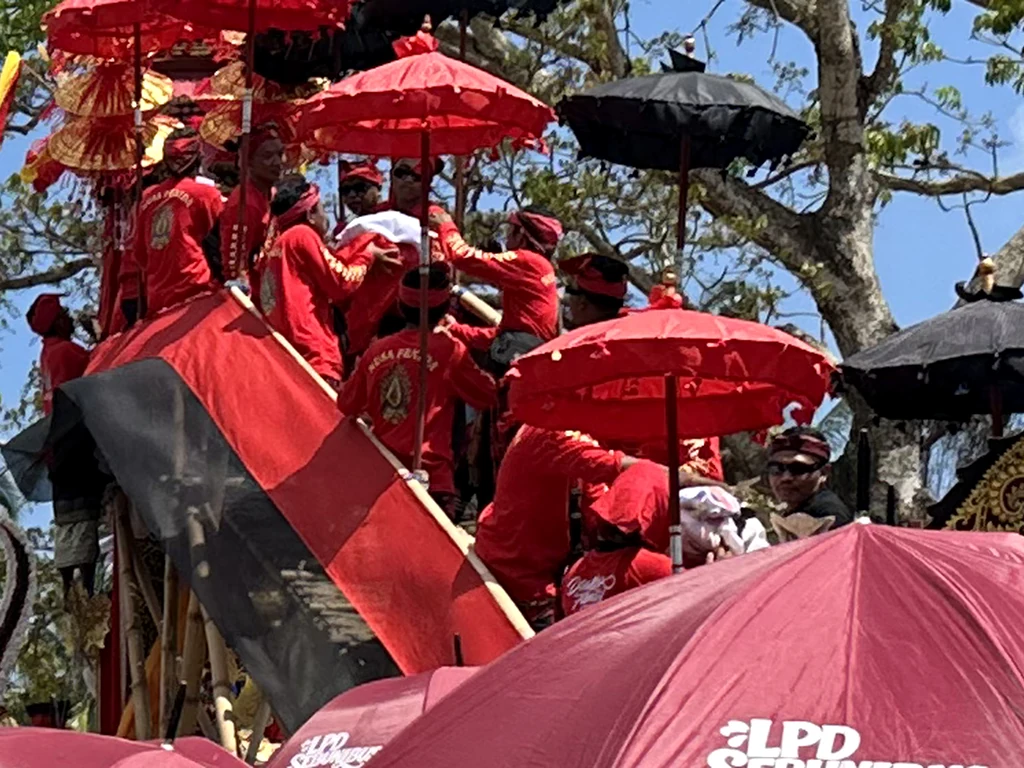
The families then carried the remains away from the tower. This moment made the purpose of the numbering system from 4 August immediately obvious: after three days and within a ceremony involving 83 deceased people, each family had to recover exactly the right remains.
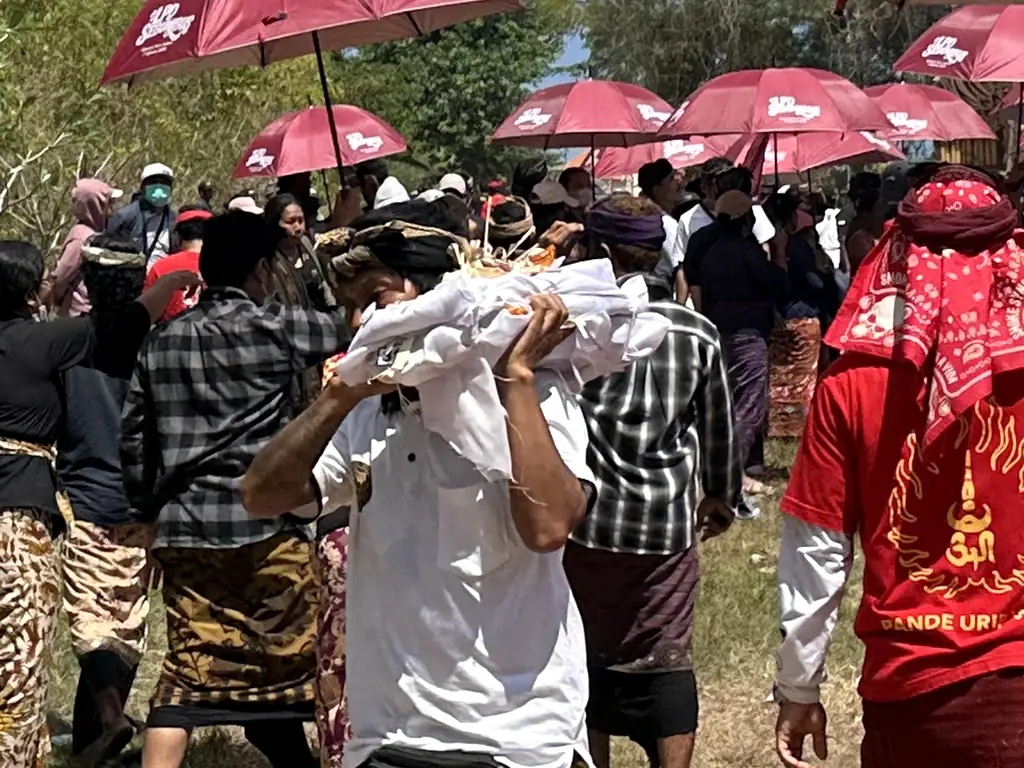
From roughly noon until 12:40 pm, the families installed the remains inside their petulangan and completed the preparations for cremation.
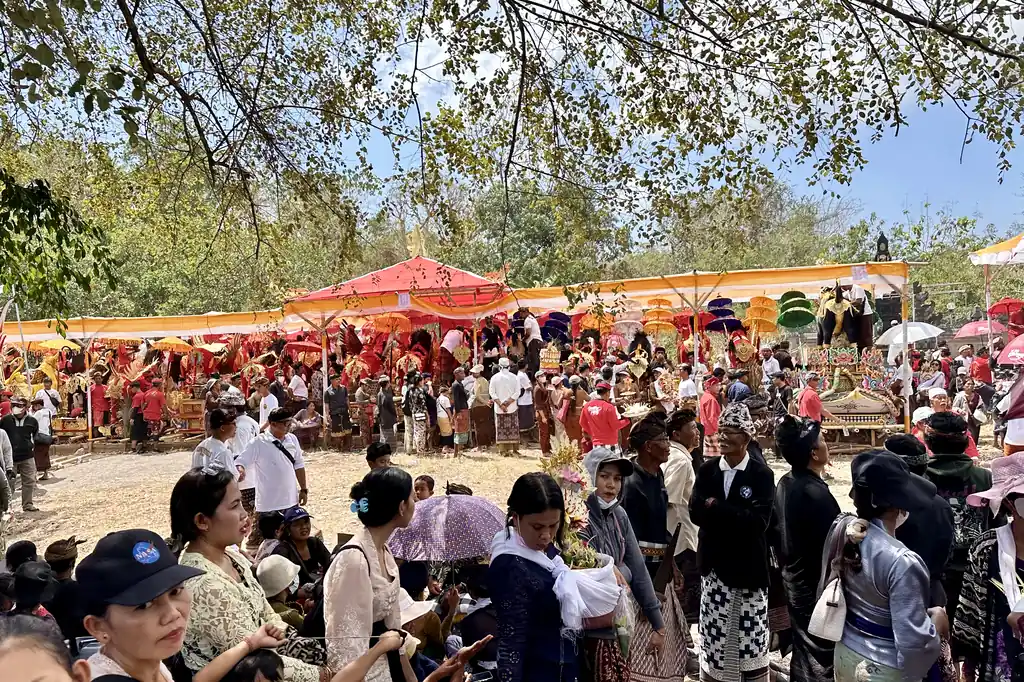
12:42 pm: the cremation begins
At approximately 12:42 pm, the signal was given over a megaphone. Men in white shirts spread out along the row of petulangan, and I was told that one representative lit the fire for each animal. I heard applause as the flames took hold.
The change was astonishingly fast. These ornate structures looked substantial, but they were made to burn. Within only a few minutes, fire had swept through the rows of petulangan. By around 12:46 pm, the heat had become so intense that everyone around me was moving back rapidly.
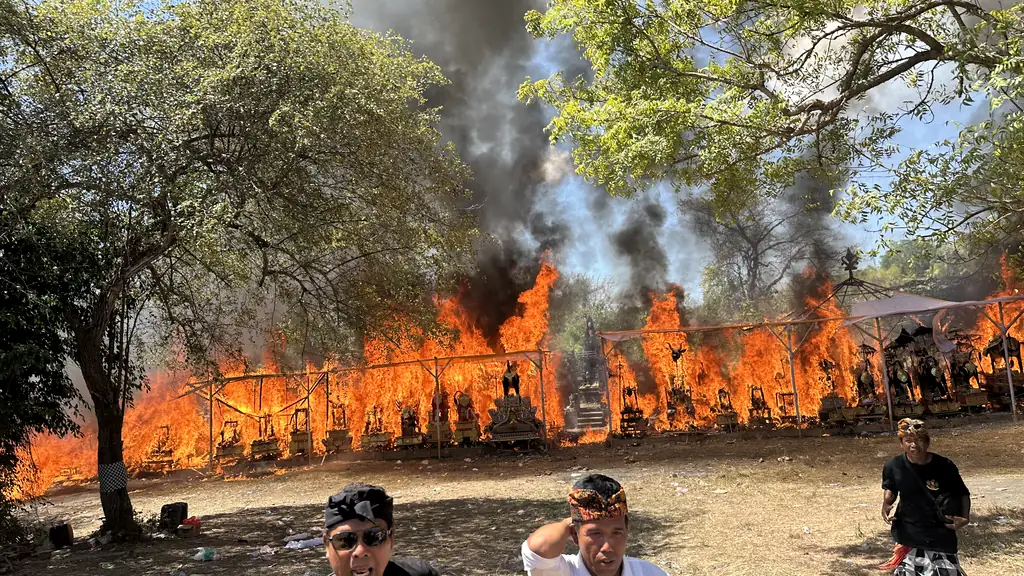
This 54-second video shows how quickly the final cremation phase unfolded in Sebunibus.
A close view makes the speed of the process even clearer. The decorated animal remains recognisable for only a short time before the flames consume the structure.
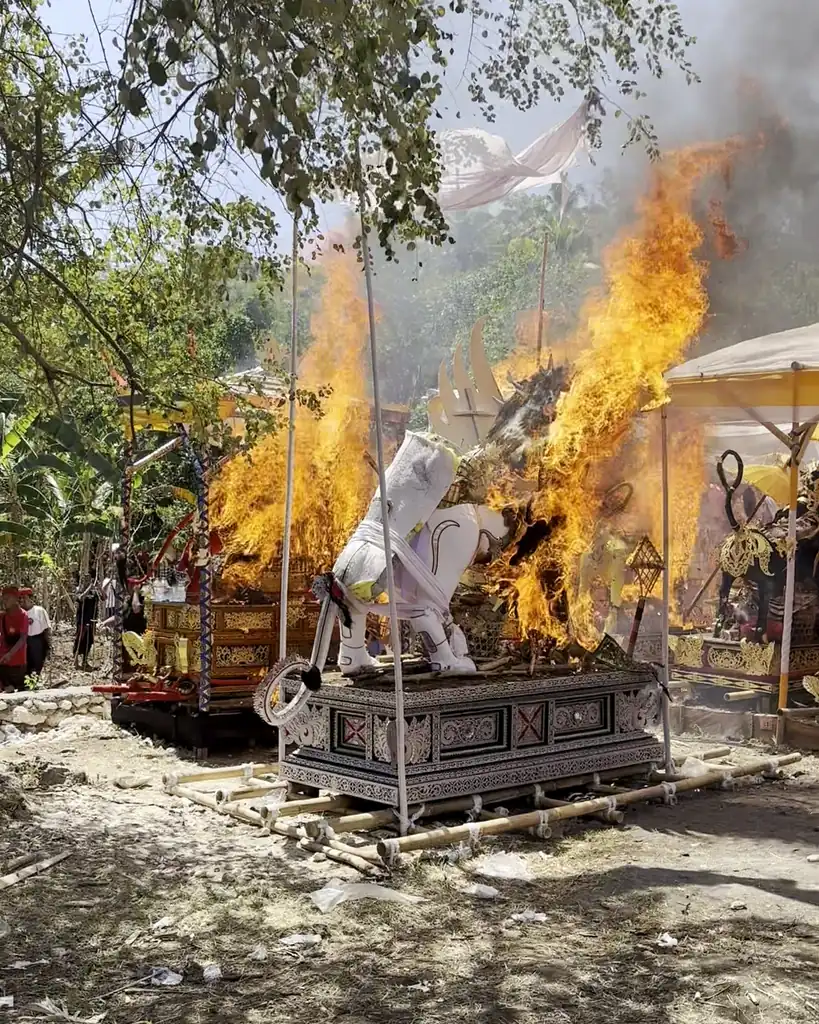
By about 12:48 pm, many people were already leaving the immediate cremation area. The visually dramatic part of Ngaben was over almost as suddenly as it had begun.
What happens after the fire?
For a visitor, it would be easy to assume that the ceremony ends when the structures burn. In Sebunibus, that would be completely wrong.
After the fire, I was told that the families recover the white calcined bones that remain and grind them down further. The ritual process then moves from sawa toward puspa. The remains or ashes are then placed with a coconut and taken to the ocean. Some days later, and before the community travels to Pura Besakih, comes a ceremony named Ngulapin: the atma is called back from the ocean to rejoin the puspa. Each family calls its own relative to its own puspa.
In the Sebunibus sequence explained to me, the next major stage takes place 12 days after the Ngaben at Pura Dalem Puri, Pura Besakih, according to the family’s soroh — Pande, Pasek and Bujanga were given as examples — followed by a stage at Pura Goa Lawah and then the return to the family temple.
This is why the fire should not be treated as the “ending” of the story. For the families, the purpose is not to watch something burn; it is to help the deceased continue a spiritual transition and ultimately take their place among the ancestors associated with the family temple.
Why Ngaben matters spiritually
The central point in the local explanation I received was not the towers, the flames or the unusual sight of an exhumation. It was that Ngaben helps the deceased continue the process of release and purification that ultimately leads toward ancestral status and the family temple.
That explanation changed the way I read the two days I had just photographed. On 4 August, relatives were not “disturbing” a grave in the Western sense of the word. They were actively caring for a family member through another necessary stage of a much longer ritual journey. On 7 August, the fire was not destruction for its own sake; it was transformation.
Can visitors attend a Ngaben in Bali?
I was told that foreign visitors are welcome as long as they are respectful. That does not mean every ceremony should be treated as an open tourist attraction. A Ngaben is first and foremost a family and community religious rite.
- Ask locally before entering a sensitive area. If you are staying nearby, your hotel, host or guide can usually tell you what is appropriate.
- Dress respectfully. I attended in Balinese ceremonial clothing with a kamen because I was accompanied by a Balinese member of the local community and was there primarily out of respect for people I knew locally.
- Follow the community’s cues. Do not block processions, stand between a family and the ritual action, or push forward for a photograph.
- Photography is not automatically taboo. At Sebunibus, local participants themselves took many photos and videos and the village shared material publicly. But that does not create a universal permission for every ceremony or every intimate moment.
- Do not stage or sensationalise what you see. Exhumed remains may be visible. For the family, these are relatives, not props for a “shocking Bali” photograph.
- Accept that you may not understand everything. Even when I asked about details — such as why two petulangan faced the opposite direction — sometimes the honest answer was simply that nobody I spoke with knew of a special meaning.
If you are planning a trip around local festivals and ceremonies, you can also read my broader guide to celebrations and ceremonies in Bali and Nusa Penida.
Ngaben can also affect travel logistics on Nusa Penida
These ceremonies are not confined to a temple courtyard; they can affect daily life across a village. On the same day as the Sebunibus cremation, 7 August 2026, another Ngaben took place at Banjar Nyuh. The harbour there was closed for the ceremony, and fast-boat companies had to modify their embarkation and disembarkation arrangements. Another ceremony took place on 20 August for the village of Sakti.
If you are travelling to Nusa Penida during a major local ceremony, allow some flexibility. Roads, harbour access or traffic may change temporarily. My guide to getting from Bali to Nusa Penida includes current practical information on boats and arrival points.
Sebunibus Ngaben timeline: 4 and 7 August 2026
| 4 Aug, 6:00 am | I meet the Balinese manager accompanying me, dress in Balinese ceremonial clothing and go to Sebunibus cemetery. |
| Early morning | Graves are blessed; instructions are given; the sawa are ritually informed that the exhumation is about to begin. |
| ~7:00 am | Families open the graves and recover the shrouded remains. |
| Morning | Bones are cleaned with water, soap and alang-alang grass, then placed in numbered bags. |
| Later morning | Families carry the remains beneath parasols in procession to the petak. |
| ~9:30 am | Dancing ends the main sequence I followed and the crowd disperses. |
| 7 Aug, ~10:30 am | The towers and petulangan are ready; the numbered remains are inside the towers. |
| ~11:45 am | Designated men lower the remains and families retrieve them by name or number. |
| 12:00–12:40 pm | Families place the remains inside the petulangan. |
| 12:42 pm | The signal is given to light the cremation fires. |
| ~12:46 pm | The blaze becomes extremely intense and the crowd moves back. |
| ~12:48 pm | Many participants begin leaving the immediate cremation area. |
| Same day | Remaining white bones are recovered and reduced further; the ritual continues toward the sea. |
| 12 days later | The next major stage takes place at Pura Besakih, followed by Pura Goa Lawah and eventual return to the family temple. |
Frequently asked questions about Ngaben
Is Ngaben the same as Pitra Yadnya?
No — but they are not two separate things either: Ngaben is part of Upacara Pitra Yadnya. Ngaben is the cremation rite most visitors know by name, while Pitra Yadnya is the broader category of rites devoted to the deceased and ancestors. In Sebunibus, the community itself labelled the August 2026 event “Upacara Pitra Yadnya”.
Are all Balinese cremated immediately after death?
No. Practice varies. In Sebunibus, many deceased were buried until the community organised a collective ceremony. Elsewhere, families may follow different arrangements, including individual Ngaben ceremonies or symbolic forms of exhumation.
Why were the bones exhumed and cleaned in Sebunibus?
The families recovered the remains as part of the preparation for the collective cremation. In Sebunibus I watched relatives clean the bones with water, soap and alang-alang grass before placing them in numbered bags. This physical exhumation is a local Sebunibus practice; I was specifically told that in another Balinese village the equivalent stage is symbolic and the bones themselves are not exhumed.
What is a petulangan?
A petulangan is the decorated animal-shaped structure in which the prepared remains are placed for cremation. In Sebunibus I saw forms including Lembu, while Singa and Macan were also identified to me in the local ritual vocabulary. In Sebunibus, I was told that the form can be associated with soroh and that several families may share a structure.
Why do the cremation structures burn so quickly?
The petulangan are highly decorated but built largely from combustible materials such as wood and paper-based decorative elements. At Sebunibus, the change from lighting the fires to an enormous wall of flame took only a few minutes.
Can tourists photograph a Ngaben?
There is no universal yes-or-no rule that should be applied blindly. At Sebunibus, local participants openly photographed and filmed the ceremony, but visitors should still ask or follow local guidance, avoid intrusive close-ups and never interfere with a family’s ritual actions.
Does the ceremony end with the cremation?
No. In the Sebunibus sequence explained to me, the remains continued through rites involving the sea, then a stage at Pura Besakih 12 days later, Pura Goa Lawah and finally the family temple. The flames are visually dramatic, but spiritually they are only one part of a much longer process.
What I took away from the Sebunibus ceremony
The image most people associate with Ngaben is fire. After these two mornings in Sebunibus, that is no longer the image that defines the ceremony for me.
I remember the families kneeling in the earth, washing the bones of their relatives with water, soap and handfuls of grass. I remember the numbered bundles held close to the body under parasols. I remember how carefully each family recovered the correct remains three days later. And then, only at the end, I remember the sudden wall of heat as the petulangan disappeared in flames.
Seen from outside, Ngaben can look spectacular. Seen from close enough to understand what the families are doing, it is primarily an act of continuity, duty and care for the deceased.
That is also why I have tried to be precise about the limits of this article. This is not “how every Ngaben in Bali works”. It is the story of the collective Pitra Yadnya I witnessed in Sebunibus, Nusa Penida, on 4 and 7 August 2026, explained to me by someone who participated in the local community and whose own village follows a different ritual practice. For me, that difference makes the ceremony more interesting, not less: Bali’s traditions are alive precisely because they are carried by real communities rather than reproduced from a single script.
All photographs in this article were taken during the Sebunibus Pitra Yadnya in August 2026. I documented the stages I personally witnessed and cross-checked the sequence and local explanations with the Balinese manager who accompanied me before drafting this guide. Broader terminology and context were then checked against sources from the Bali Provincial Government, Indonesia’s Ministry of Religious Affairs, the Klungkung Regency Government and academic literature. Local Sebunibus practices are identified as such rather than presented as universal rules for Bali.