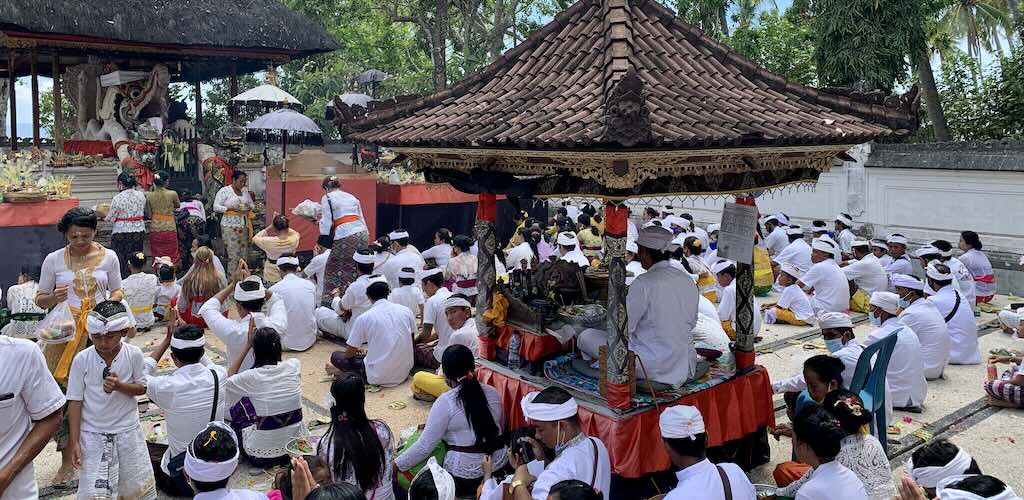
Nyepi 2027 in Bali falls on March 9, 2027.
Nyepi is Bali’s famous Day of Silence. On this day, the entire island shuts down completely:
- no flights
- no transport
- no activities
- no lights
Nyepi is the most unique celebration in Bali and one of the most fascinating cultural experiences in the world. And the Ogoh Ogoh parade the night before Nyepi is one of the most spectacular festivals in Bali. Nyepi takes place every year on a different date, usually in March.
👉 In this guide, you’ll find the exact dates, rules, Ogoh Ogoh festival, together with all the other Bali ceremonies explained.
Overview of the main ceremonies in Bali
Bali is known for its vibrant culture and the many religious ceremonies that take place throughout the year. The most important ones include:
- Nyepi – the famous Day of Silence
- Galungan & Kuningan – celebrating the victory of good over evil
- Odalan – temple anniversaries held every 210 days
- Ngaben – the traditional Balinese cremation ceremony
👉 Visiting Bali during these ceremonies is one of the most authentic and memorable experiences on the island.
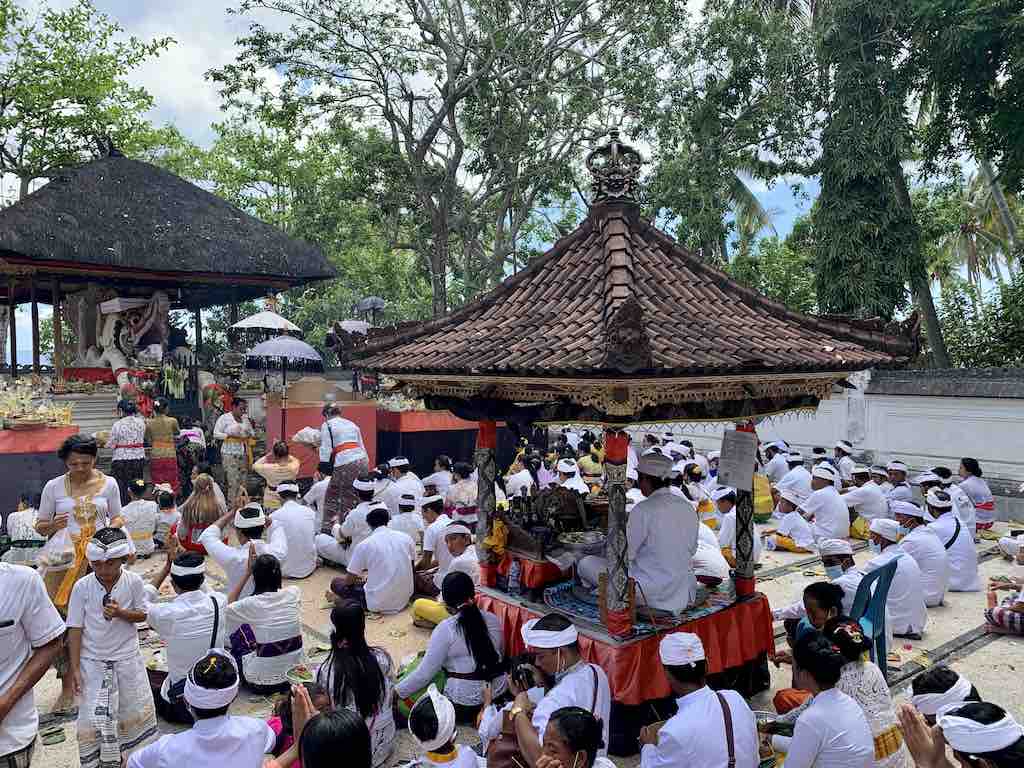
Bali Ceremony Calendar 2026–2027
Ceremonies in Bali follow two traditional calendars: the Pawukon calendar (210-day cycle) and the Saka calendar (lunar-based).
👉 As a result, celebrations take place throughout the year, with dates changing annually.
🎎 Main Bali Festivals (2026–2027)
Nyepi (Balinese New Year / Day of Silence)
👉 March 19, 2026
👉 March 9, 2027
Galungan (victory of Dharma over Adharma)
👉 June 17, 2026
👉 January 13, 2027 & August 11, 2027
Kuningan (end of the Galungan period)
👉 June 27, 2026
👉 January 23, 2027 & August 21, 2027
🔄 Recurring Ceremonies Throughout the Year
In addition to major festivals, many rituals take place regularly:
- Odalan → temple anniversary, every 210 days
- Kajeng Kliwon → every 15 days (important spiritual day)
- Tumpek → every 35 days (honoring nature, objects, and life)
👉 This means that there is almost always a ceremony happening somewhere in Bali, whether in villages or temples.
🌴 Tips for Travelers
If you want to experience Balinese ceremonies:
- Visit local temples
- Ask your hotel or local residents about current events
- Check the Bali calendar before your trip
The two balinese calendars in Bali
The ceremonies, celebrations and events follow two different calendars used by the Balinese:
- The Pawukon calendar, whose year consists of only 210 days
- The Saka calendar, which comes from the Indian system. Each month begins with the new moon, an occasion for great ceremonies.
The main celebrations in Bali
Odalan celebrations
Odalan celebrates the arrival of the gods on the anniversary of each temple’s foundation. It takes place every 210 days since the temple’s foundation (once per year of the Pawukon cycle). Thus, the date is different for each temple. Some Odalan ceremonies last only 1 to 3 days, while others can last up to a month. Once the main religious ceremony is over, Odalan becomes more of a social occasion to meet its neighbors.
Galungan et Kuningan celebrations
Galungan celebrates the creation of the universe, the victory of the good, Dharma, against the evil, Adharma. The celebrations always take place on a Wednesday. The celebrations preparations start on the previous Monday, with the preparation of the cakes that will serve as offerings. Then, on Tuesday, men prepare the festive dinner (they kill pigs, to turn them into kebabs and blood sausages) and women prepare the offerings. Each house has to install a Penjor , a huge bamboo pole with colorfull offerings, before Penampahan day, the day before Galungan.
These festivities last 10 days and come to an end with Kuningan, which celebrates purification. On that same day, the ancestors’ souls are leaving their family’s temple.
Upcoming Galungan/Kuningan dates in Bali are :
- 17 & 27 June 2026
- 13 & 23 January 2027
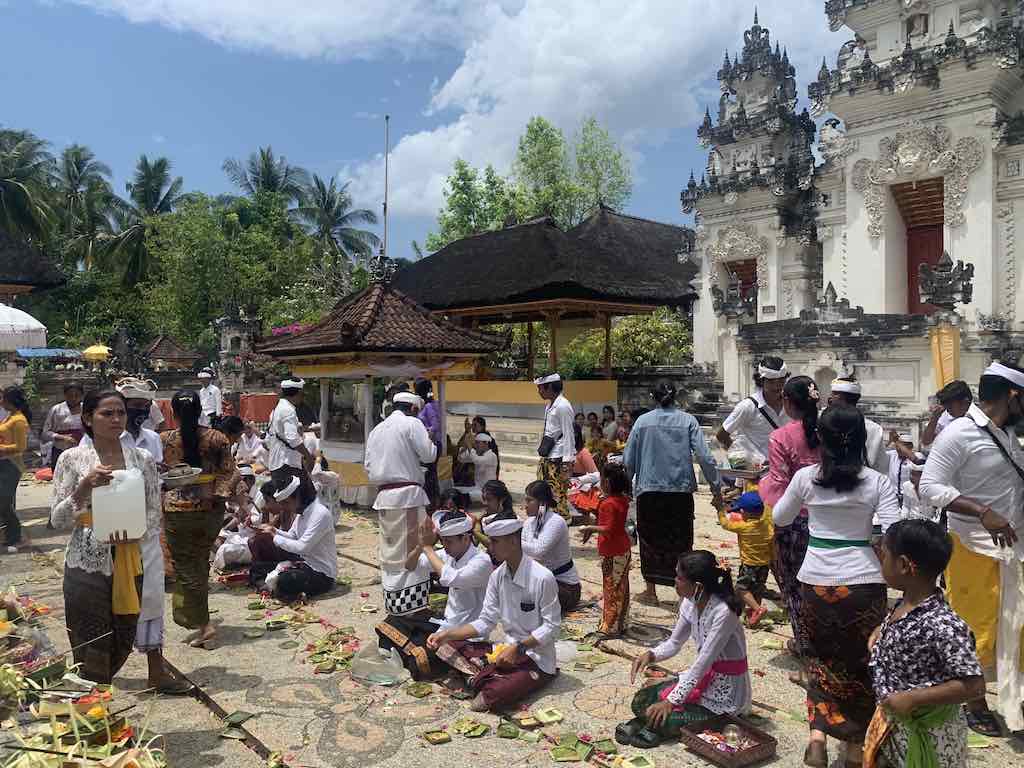
Saraswati celebrations
Saraswati celebrates the goddess of knowledge. The children, who pray and bring offerings to the temple of their school, mainly celebrate it. The Balinese also pay homage to the goddess and books by sprinkling holy water.
Upcoming Saraswati dates in Bali are :
- 4 April 2026
Pagerwesi celebrations
Pagerwesi is the festival to spiritual strengthening and development of individuals’ forces against evil. Pager means : bareer and Wesi : metal. Therefore it means that everyone must surround themselves with strong fortifications against the forces of evil. All Balinese place offerings at their family temple and at other temples in order to be protected from any negative element.
Upcoming Pagerwesi dates in Bali are :
- 8 April 2026
Tumpek celebrations
Every 35 days, the Balinese make offerings to items or valuable property :
- Music instruments, masks and outfits used during ceremonies (Tumpek Krulut) : August 1, 2026
- Pets and especially cattle (Tumpek Kandang) : February 7, 2026, and September 5, 2026
- Puppets (Tupek Wayang) : March 14, 2026, and October 10, 2026
- Iron objects such as cars, motorbikes, televisions, knives… (Tumpek Landep) : April 18, 2026, and November 14, 2026
- And trees (Tumpek Uduh) : May 23, 2026, and December 19, 2026
Kajeng Kliwon
On the day of Kajeng Kliwon the Hindu people of Bali purify themselves in order to receive strength and power. This day is also auspicious for the pamusapati, a ceremony in which the spirit is invited into sacred objects such as the barong, the rangda, the mask, the amulets, the kris etc. to give them spiritual power.
There are two Kajeng Kliwon: Kajeng Kliwon Uwudan and Kajeng Kliwon Enyitan. Kajeng Kliwon Uwudan neutralizes the negative powers and Kajeng Kliwon Enyitan increases the positive powers.
The rituals of both ceremonies are based on sincerity and honesty.
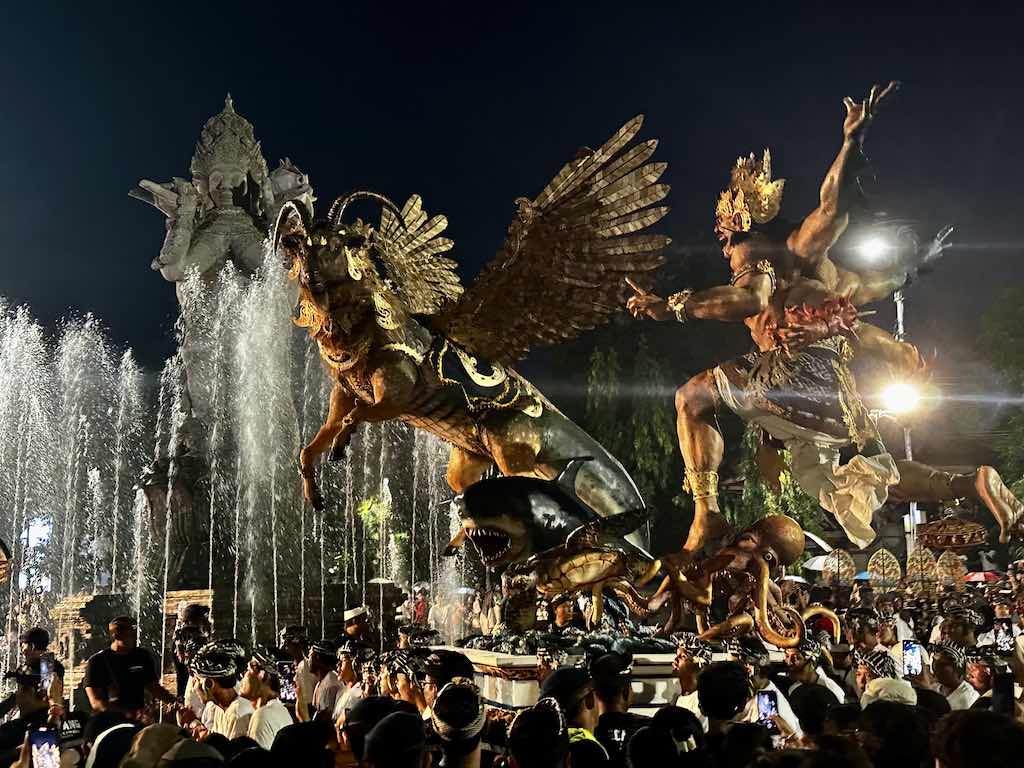
Nyepi celebrations
Nyepi is the Balinese New Year (of the Saka calendar). It takes place in March or April according on the Balinese calendar.
It corresponds to a day of silence, meditation, in order to refocus and liberate the minds from negative emotions. This silence is supposed to convince demons that the island is deserted, so that they will not come back to disturb its inhabitants.
What happens during Nyepi in Bali ?
During Nyepi, the entire island of Bali shuts down, and people are not allowed to leave their homes, hotels, or villas. All businesses are closed, and no lights, music, or noise is allowed. Even the airport is closed for the day. But public services, such as hospitals and fire departments, remain open for emergencies.
Pecalang, traditional security officers, patrol the streets to ensure the peace and serenity of Nyepi is maintained. There is therefore no light or sound pollution, which means ideal conditions to meditate and watch the stars ! But you need to book the right hotel or resort that will offer you food and drinks.
Nyepi, is preceded by Melasti, which is celebrated throughout the whole island of Bali. It corresponds to the great purification. On this occasion, the Balinese go to the sea or to a natural water source to purify their bodies and their sacred objects. But the day before Nyepi, the main road junctions receive large offerings supposed to exorcise evil spirits.
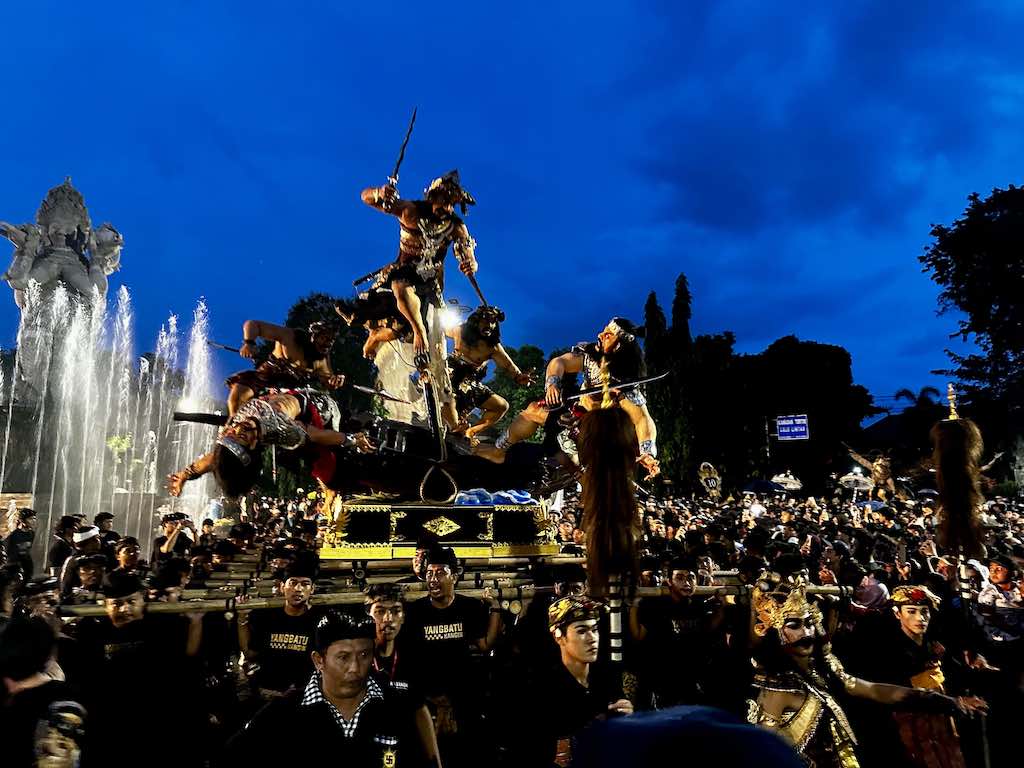
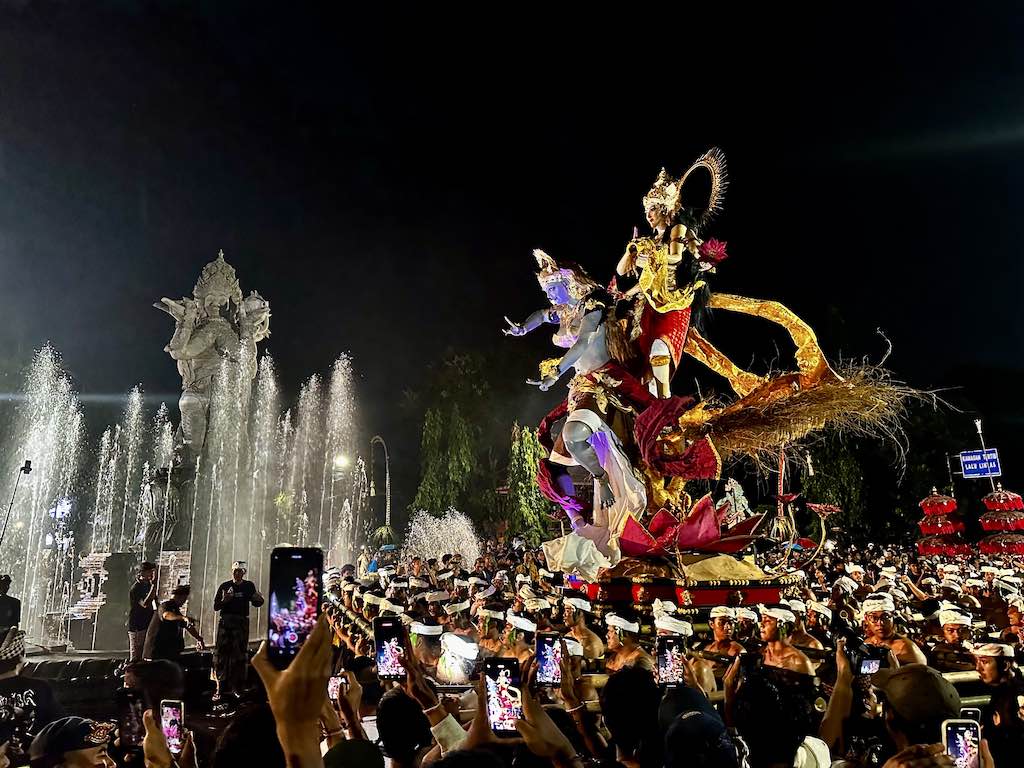
The Ogoh Ogoh parade
What is the Ogoh Ogoh festival ? The day before Nyepi, known as Ngrupuk, people take to the streets to make noises to ward off evil spirits. Tourists can enjoy watching the Balinese people parade around with handmade floats depicting demons and evil spirits called ogoh-ogoh. Cymbals and firecrackers accompany the procession to frighten off evil spirits.
Do and don’t during Nyepi in Bali
To respect the culture and tradition of Nyepi, visitors and residents are advised to follow these dos and don’ts strictly.
DO
- Respect the customs and traditions of Nyepi, which is a sacred day for the Balinese people
- Stay inside your accommodation or villa, and use this time for self-reflection, meditation or relaxation
- If your hotel do not provide food during Nyepi, be prepared with enough food and drinks to last the entire day .
- Since ATMs usually go offline on the day before Nyepi, it’s a good idea to withdraw cash in advance just in case.
- Book your accommodations early as many hotels and villas get fully booked during Nyepi.
- During the days leading up to Nyepi, you may encounter street closures for traditional ceremonies. If this happens, please be patient and find an alternative route. Avoid arguing with security officers.
- To show respect for the tradition of Nyepi, turn off all lights and electronic devices, especially if they’re visible from the outside.
DON’T
- Violate the restrictions of Nyepi by leaving your accommodation or villa, making noise, or using any form of transportation
- Take photographs or videos during Nyepi, which is considered disrespectful and intrusive
- Engage in any activities that disturb the peace and harmony of the day, such as smoking, drinking, or partying
- Ignore the customs and traditions of Nyepi, or treat it as just another holiday or vacation day
- Forget that
Nyepi is an opportunity to connect with yourself, with nature, and with the Balinese community in a meaningful way.
Nyepi in Nusa Penida
Because the Nyepi silence day originated in Nusa Penida, the inhabitants follow the tradition strictly. During Nyepi Day, which falls on Thursday, March 9, 2027, PLN electricity will be limited to powering refrigerators, water heaters, medical equipment, and lighting for sick residents, those with babies aged 6 months and under, and Yadnya ceremonies (for essential lighting only). There should also be no boat from or to Nusa Penida on the 8th afternoon. To know more, you can read about the history of Nyepi.
For the tourists, it means that everywhere in the Nusa Penida islands, everything will be closed (shops, transport, restaurants, etc.). There will be no electricity and no internet. No fires are allowed. You are not allowed to go out on the streets. So the best is to take some time to enjoy the stars during the night (no light pollution) and the serenity, and to meditate. But also to be prepared by stocking up on water and food the day before Nyepi. Or to choose the proper hotel and resort, preferably with a pool, that will provide you with food and drinks.
Nyepi 2027 and Nyepi 2028 in Bali are on :
- Nyepi 2027: March 9, 2027
- Nyepi 2028: February 26, 2028
Nyepi Segara in Nusa Penida (Nyepi Laut)
The maritime version of the Nyepi silence day is called Nyepi Laut or Nyepi Segara, which is practiced only on the 3 islands of Nusa Penida. That day, there is no maritime activity on Nusa Penida, Nusa Lembongan, and Nusa Ceningan. No boat to join or leave the islands, no boat between the islands, no scuba diving, no snorkeling. And no activity involving the sea, like swimming or walking on the beach.
The goal of this day is to honor and appease Dewa Baruna, the ruler of the seas and oceans. This ritual practice started in the 17th century, under the reign of Dalem Waturenggong in the Klungkung regency. The ritual practice of this day includes meditation and silent contemplation on the importance of the aquatic environment. That is why it is better that day to wear a sarong to cover one’s legs and a modest shirt or blouse to cover one’s shoulders.
Nyepi Segara (Nyepi Laut) takes place on the fourth full moon of the Balinese calendar.
Nyepi Laut 2026 in Nusa Penida will take place on :
- September 26 2026
Ngaben (cremation ceremony)
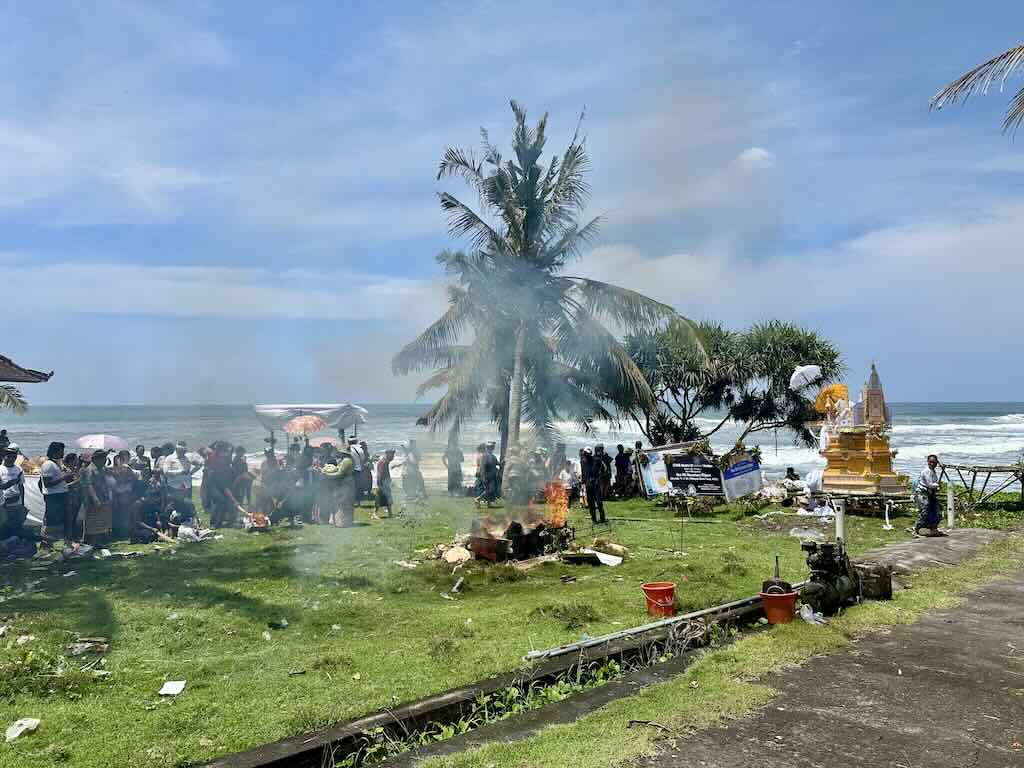
Ngaben, the traditional Balinese cremation ceremony, is a sacred Hindu ritual that honors the deceased and guides their soul to the afterlife. It is a vibrant and elaborate event, reflecting the Balinese belief in reincarnation and the cyclical nature of life. The ceremony involves a series of intricate rituals, including prayers, offerings, and the construction of an ornate cremation tower (bade). Or a sacred bull-shaped sarcophagus (lembu).
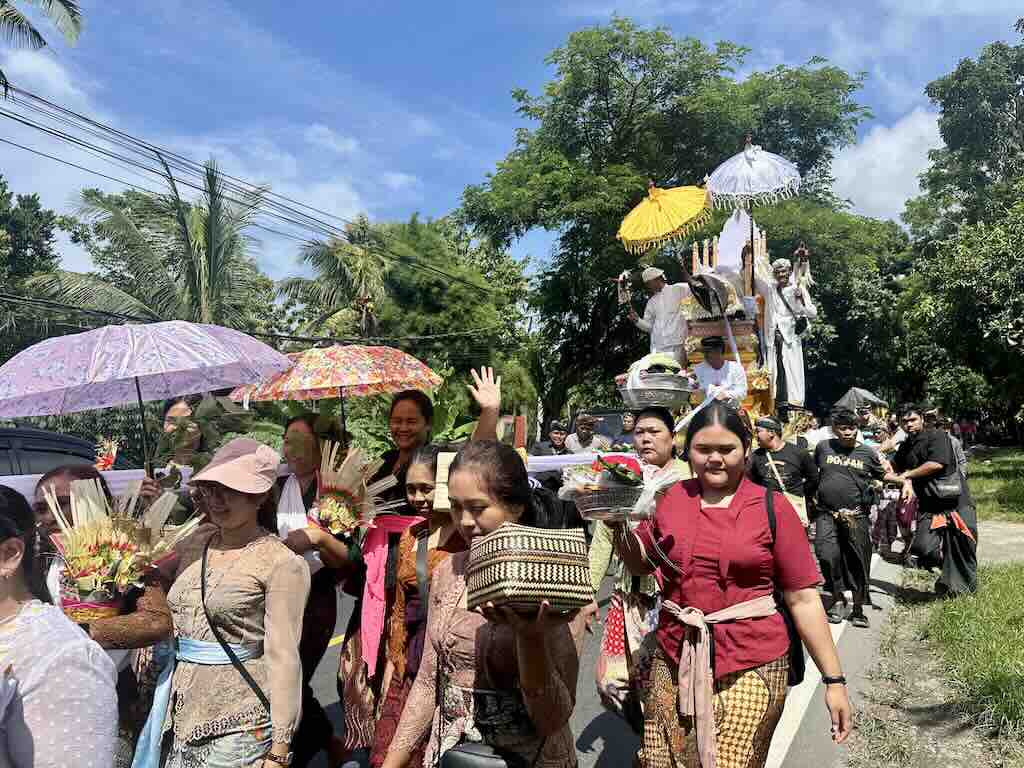
Family members, dressed in ceremonial attire, accompany the procession to the cremation site, where priests perform blessings before the body is set aflame. Unlike mourning customs in many cultures, Ngaben is a joyous occasion, as it is seen as liberating the soul from earthly attachments, allowing it to continue its spiritual journey. The grandeur of the ceremony varies depending on the family’s status, with royal and noble families often hosting large, elaborate processions. However, in some cases, communal Ngaben ceremonies are held to accommodate families who cannot afford an individual cremation.
Independence day of Indonesia
On August 17, Indonesians celebrate independence by holding flag-raising ceremonies at schools and offices. Try to attend to some of the afternoon games organized in many villages and cities ! But wherever you are in Bali, you will see the Indonesian flag everywhere!
Independence day :
- August 17th
2026 National holidays in Indonesia
The list of national holidays in 2026 is as follows:
- Jan 1 (Thu): New Year’s Day
- Jan 16 (Fri): Isra Mi’raj
- Feb 17 (Tue): Chinese New Year
- Mar 19 (Thu): Nyepi Day
- Mar 21–22 (Sat-Sun): Eid al-Fitr
- Apr 3 (Fri): Good Friday
- Apr 5 (Sun): Easter Sunday
- May 1 (Fri): Labor Day
- May 14 (Thu): Ascension of Jesus Christ
- May 27 (Wed): Eid al-Adha
- May 31 (Sun): Vesak Day
- Jun 1 (Mon): Pancasila Day
- Jun 16 (Tue): Islamic New Year
- Aug 17 (Mon): Independence Day
- Aug 25 (Tue): Prophet Muhammad’s Birthday
- Dec 25 (Fri): Christmas Day
Collective leave (Cuti Bersama)
‘Cuti Bersama’ is an expression that means “to go together or to bridge the gap”. These days compensate for a public holiday which, for example, falls on a Saturday or Sunday. For Idul Fitri, employees can take a week of leave to return to their hometowns or villages to celebrate the holiday with family. The Cuti Bersama is not fixed; During the year, and depending on events, the government may add more. You should know that Cuti Bersama is deducted from vacation days, unlike public holidays, which are added to them. Private companies are not obliged to apply them, but some large groups do.
The list of mass leaves for 2026 is:
- Feb 16 (Mon): Chinese New Year
- Mar 18 (Wed): Nyepi Day
- Mar 20, 23, 24 (Fri, Mon, Tue): Eid al-Fitr
- May 15 (Fri): Ascension of Jesus Christ
- May 28 (Thu): Eid al-Adha
- Dec 24 (Thu): Christmas Day

Nusa Penida Travel Guide
Plan your trip to Nusa Penida with our local expert guide: beaches, diving sites, hotels, transport tips, itineraries and seasonal advice.

Where to stay in Nusa Penida
How to choose where to stay in Nusa Penida among the 500 listed hotels. 5 stars, boutique hotel, glamping or charming bungalows?

Top 15 to see in Nusa Penida
After more than 10 years exploring Nusa Penida, I’ve updated my list of the 15 most incredible places to see on the island — from stunning beaches to dramatic cliffs.
FAQ – Bali Ceremonies & Nyepi
What is the Day of Silence in Bali?
Nyepi, the Day of Silence, is the Balinese New Year. The entire island shuts down for 24 hours with no activities, lights, or travel.
Can you go outside during Nyepi?
No, everyone—including tourists—must stay inside their accommodation and respect the silence.
When is Nyepi 2027?
Nyepi 2027 falls on March 9, 2027.
When is Nyepi 2028?
Nyepi 2028 falls on February 26, 2028.
What happens during Nyepi in Bali?
The entire island shuts down completely:
- no activities
- no transport
- no flights
- no lights
Do tourists have to follow Nyepi rules?
Yes, everyone must stay inside their accommodation and respect the rules of silence.
Are there ceremonies in Bali every day?
Yes, ceremonies take place daily across Bali, depending on the Pawukon and Saka calendars.
What ceremonies are happening in Bali today?
It varies every day, but there is almost always a ceremony in a village or temple somewhere on the island.
What are Balinese ceremonies?
They are Hindu religious rituals performed throughout the year, deeply rooted in Balinese culture and daily life.
When are Galungan and Kuningan in 2026?
- Galungan: June 17, 2026
- Kuningan: June 27, 2026
When are Galungan and Kuningan in 2027?
- Galungan: January 13 & August 11, 2027
- Kuningan: January 23 & August 21, 2027
What is Nyepi Segara in Nusa Penida?
Nyepi Segara is a “Day of Silence at sea,” when all marine activities are stopped around Nusa Penida.
When is the best time to see ceremonies in Bali?
All year round, especially during major festivals like Nyepi, Galungan, and Kuningan.